
Beef Wellington (Ultimate Step-by-Step Guide)
This post may contain affiliate links.
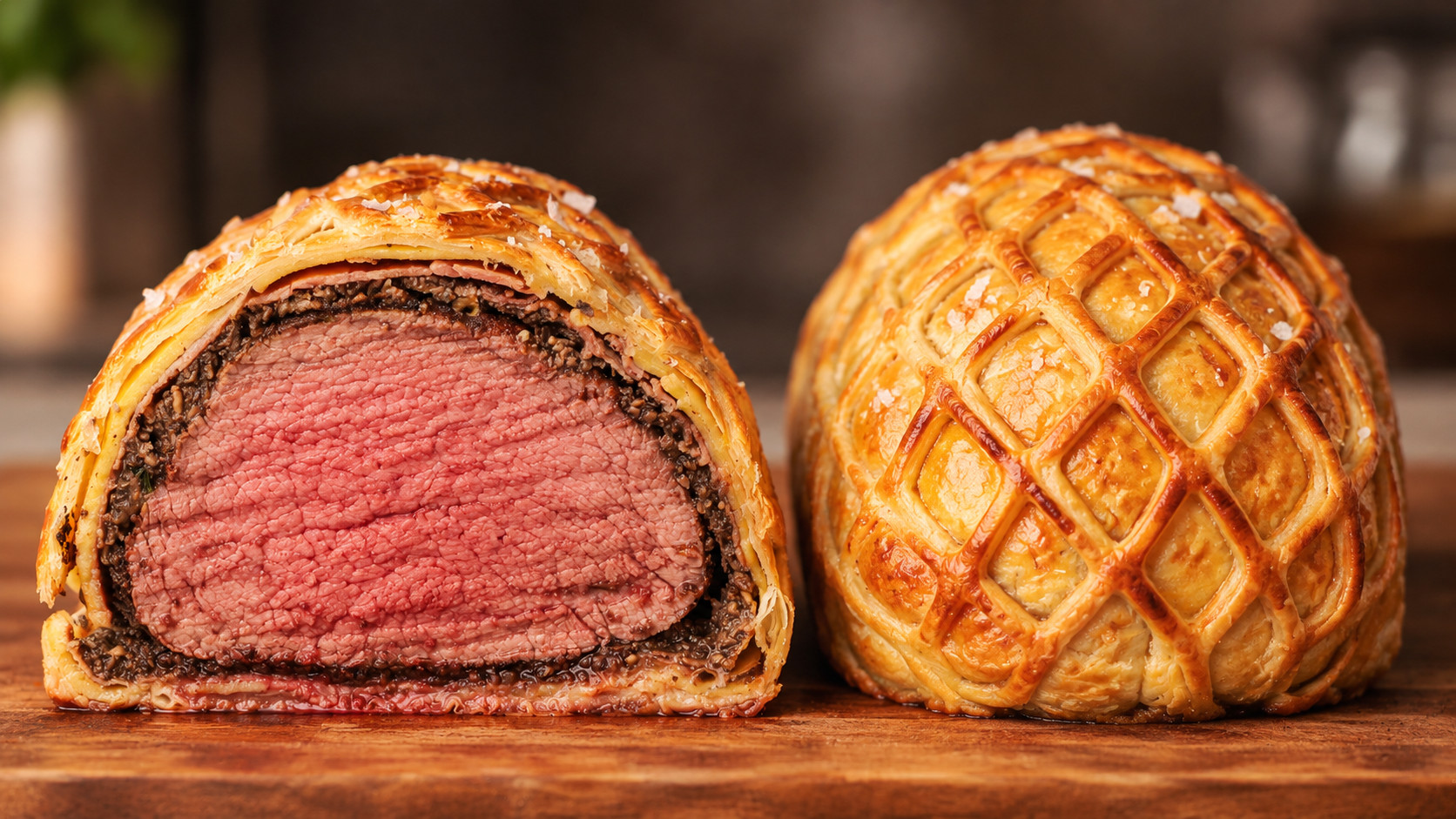
This classic beef Wellington recipe combines tender beef fillet, savory mushroom duxelles, prosciutto and delicate crêpes inside golden, flaky puff pastry. With detailed instructions, a full video and an optional lattice topping, it’s a beautiful centerpiece for Christmas dinner, New Year’s Eve or a special celebration.
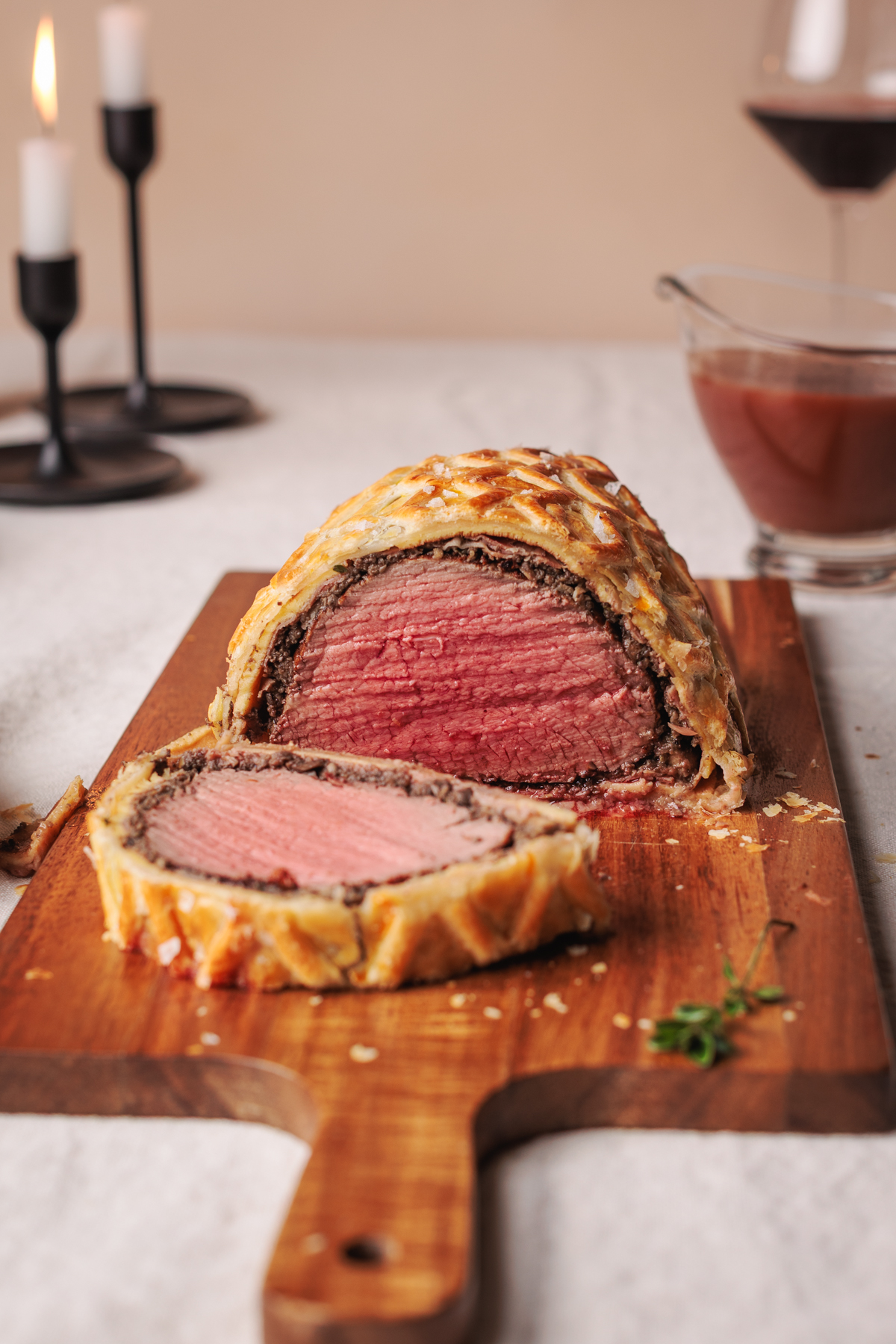
I’ll be honest: this is a longer post than I usually write. Like my apple pie guide, I wanted to explain the details that can make the difference between a good result and a disappointing one. I tested this Wellington four times while developing the recipe, and yes, a few things went wrong along the way. I’d rather make those mistakes in my kitchen than have you discover them with an expensive piece of beef!
Beef Wellington takes time, and I know it can look intimidating. But trust me: once you understand the layers and what to look for at each stage, it becomes much more manageable. In this foolproof, step-by-step guide, I’ll walk you through everything, including one small crêpe mistake I learned the hard way, so you can approach it with confidence.
💡 I highly recommend watching my full video before you start. Seeing the wrapping and lattice steps makes them much easier to understand. Read through the recipe too, especially the chilling stages, before planning when to serve dinner.
Beef Wellington Video Recipe
Watch the full video recipe to learn how to make the BEST Beef Wellington recipe.
Prefer the written recipe? Scroll down to the recipe box 👇
Ingredients and Important Notes
The full ingredient quantities are in the recipe card. These are the choices worth paying attention to before shopping.
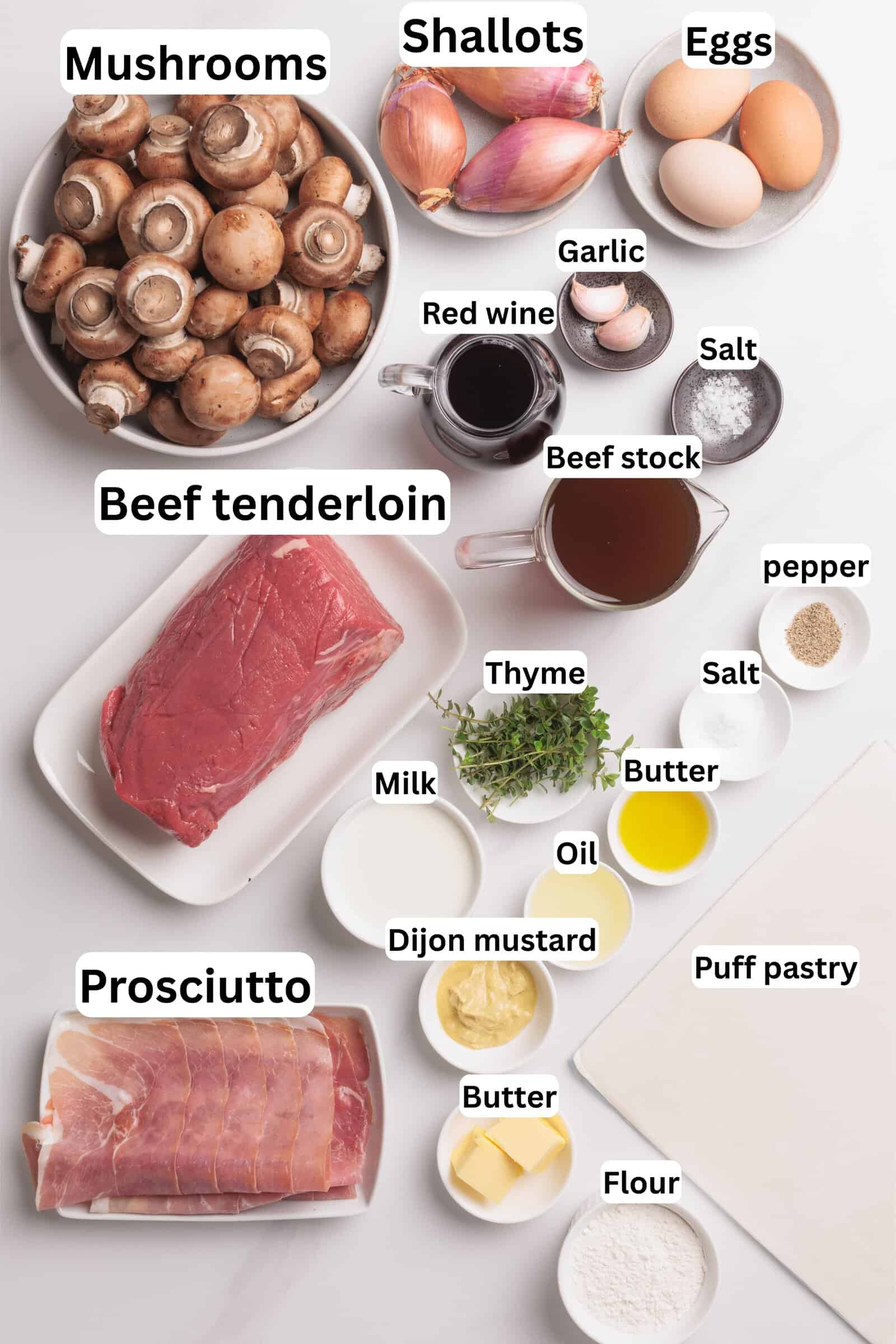
- Beef tenderloin: Use 900–1,200g of trimmed, center-cut tenderloin, sometimes sold as chateaubriand. See the section below for what to look for and suitable alternatives.
- Mushrooms: Cremini, also called chestnut mushrooms, give the duxelles a good savory flavor. White button mushrooms work too, or replace part of the cremini with shiitake. “Chestnut mushrooms” are a mushroom variety; they are not actual chestnuts.
- Shallots, garlic and thyme: These flavor the mushroom layer without overpowering the beef.
- Dijon mustard: Brush it over the seared beef for a little sharpness that balances the rich pastry and filling.
- Prosciutto: Use thin slices that overlap easily. You need enough to cover the crêpe rectangle; the exact number depends on the size of the slices and your beef.
- Crêpes: These should be thin and plain, with no sugar or vanilla. Their job is to add a protective layer, not a thick pancake around the filling.
- Puff pastry: I recommend good-quality all-butter puff pastry, thawed according to the package instructions but still cold. The recipe allows about 680g across two sheets: one for enclosing the beef and another for the optional lattice. Sheet sizes vary, so coverage matters more than sheet count.
- Egg yolks: Mixed with a little water or milk, they help seal the seams and give the pastry its golden finish.
Choose The Right Cut
For this recipe, I recommend 900–1,200g (about 2–2⅔ pounds) of center-cut beef tenderloin, also called beef fillet and often sold as chateaubriand. It’s tender enough for the short cooking time inside the pastry.
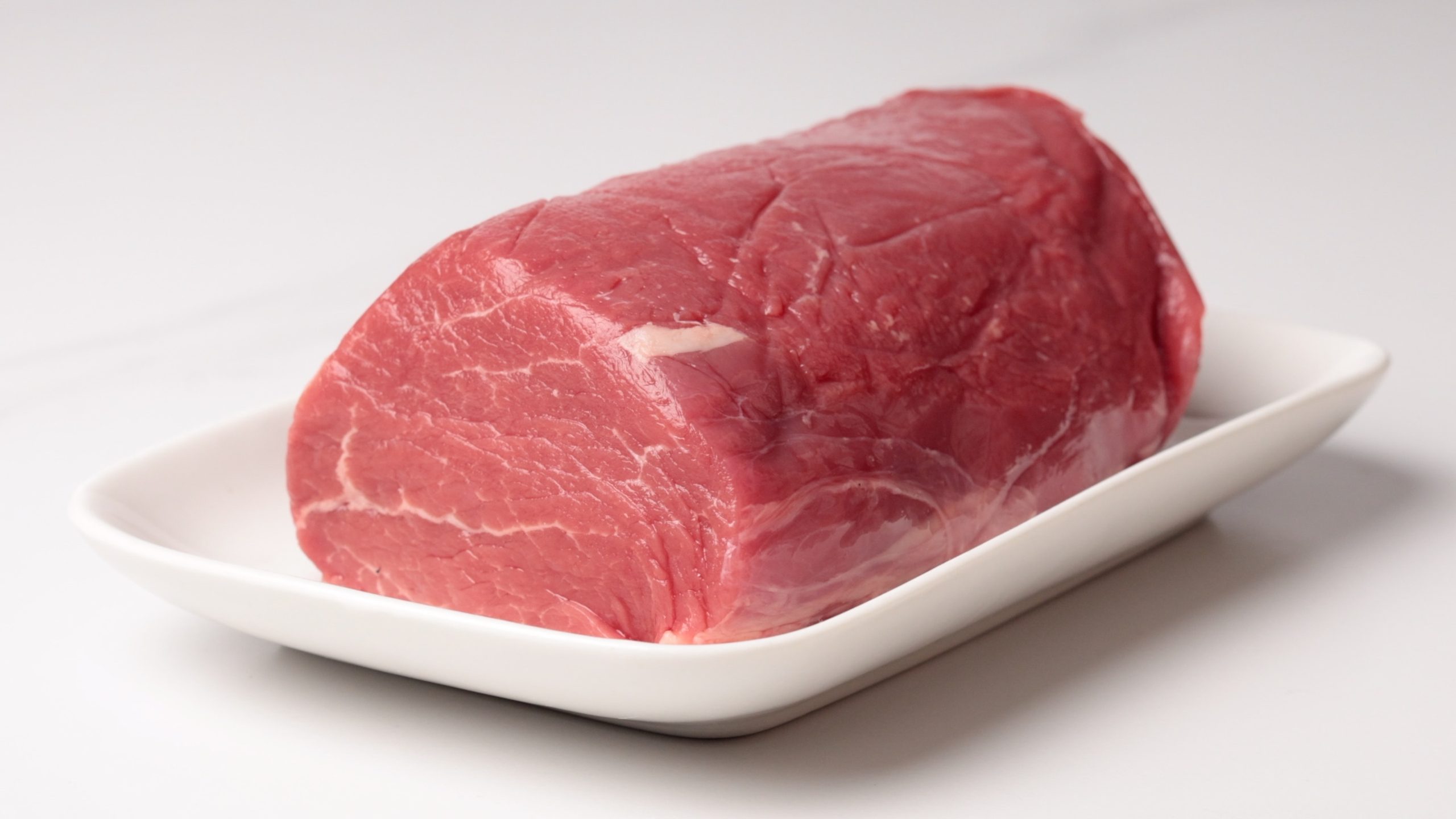
- Look for: A thick, evenly shaped piece with a similar diameter from end to end. Ask your butcher to remove the silver skin and excess surface fat.
- Avoid: Thin, tapered tail pieces, which cook unevenly, and tough cuts such as chuck or brisket, which need much longer cooking.
- Alternatives: Tenderloin is the traditional choice and, in my opinion, gives the best result. However, these options can work if you’re happy with a different texture:
- Center-cut sirloin: A more affordable option with good beefy flavor, although it won’t be as tender. Choose a thick, evenly shaped piece.
- Striploin (New York strip): Another option for a steak-style Wellington. Have the thick fat cap and tough connective tissue trimmed away; expect a firmer bite than tenderloin.
- Ground beef: Works for a budget-friendly, meatloaf-style Wellington, but gives a completely different texture. Use a recipe developed for ground beef rather than swapping it directly into this one.
How to Make Beef Wellington
Allow roughly 3–4 hours from scratch, including cooling, chilling, baking and resting. This is a planning estimate: you can make the mushrooms and crêpes while the beef chills, but don’t rush the cold stages to meet a deadline.
Prepare and Sear the Beef
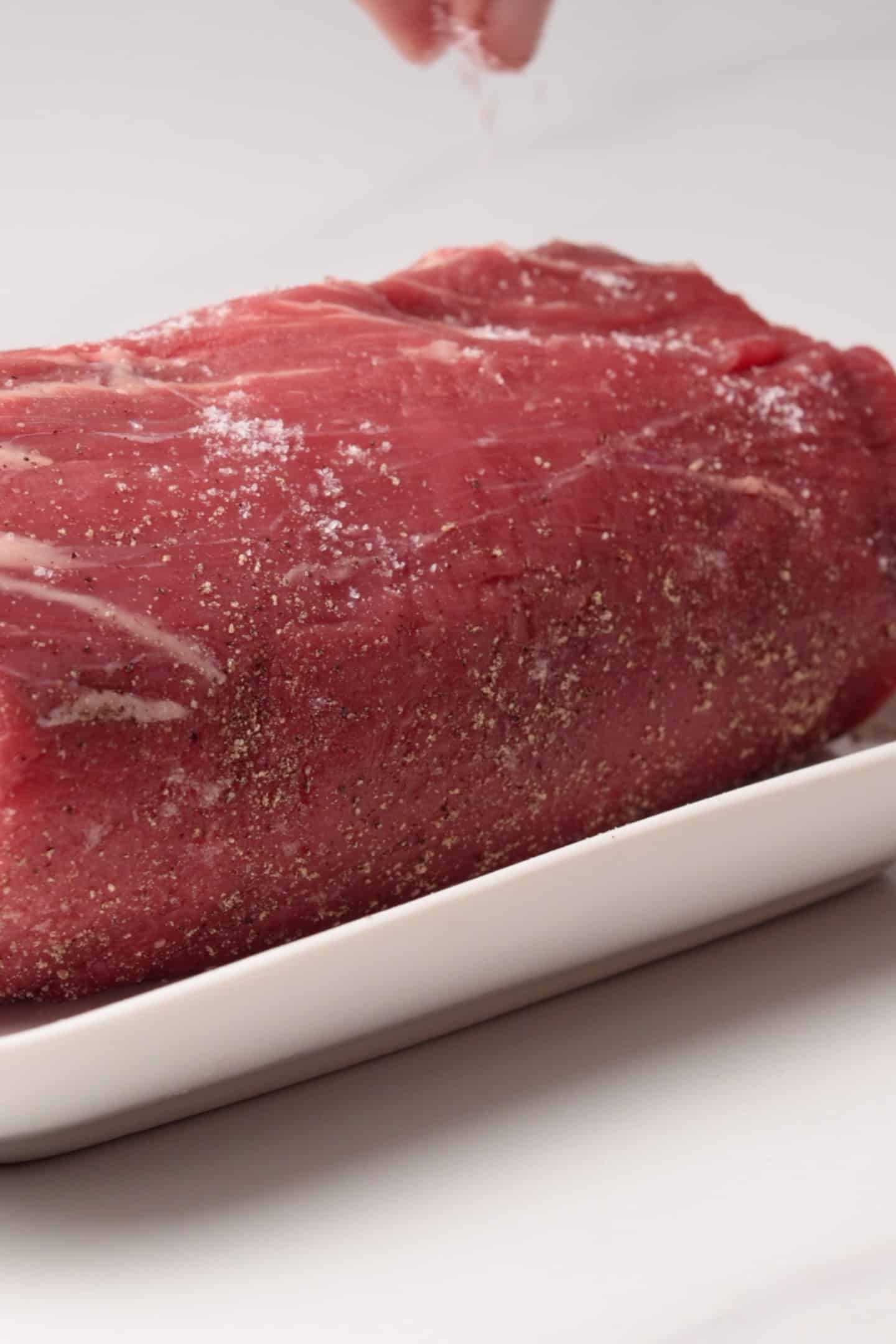
- Prepare: Check that the beef is trimmed of silver skin and excess surface fat. Tie with butcher’s twine if needed to hold an even shape, then pat dry and season all over with salt and pepper.
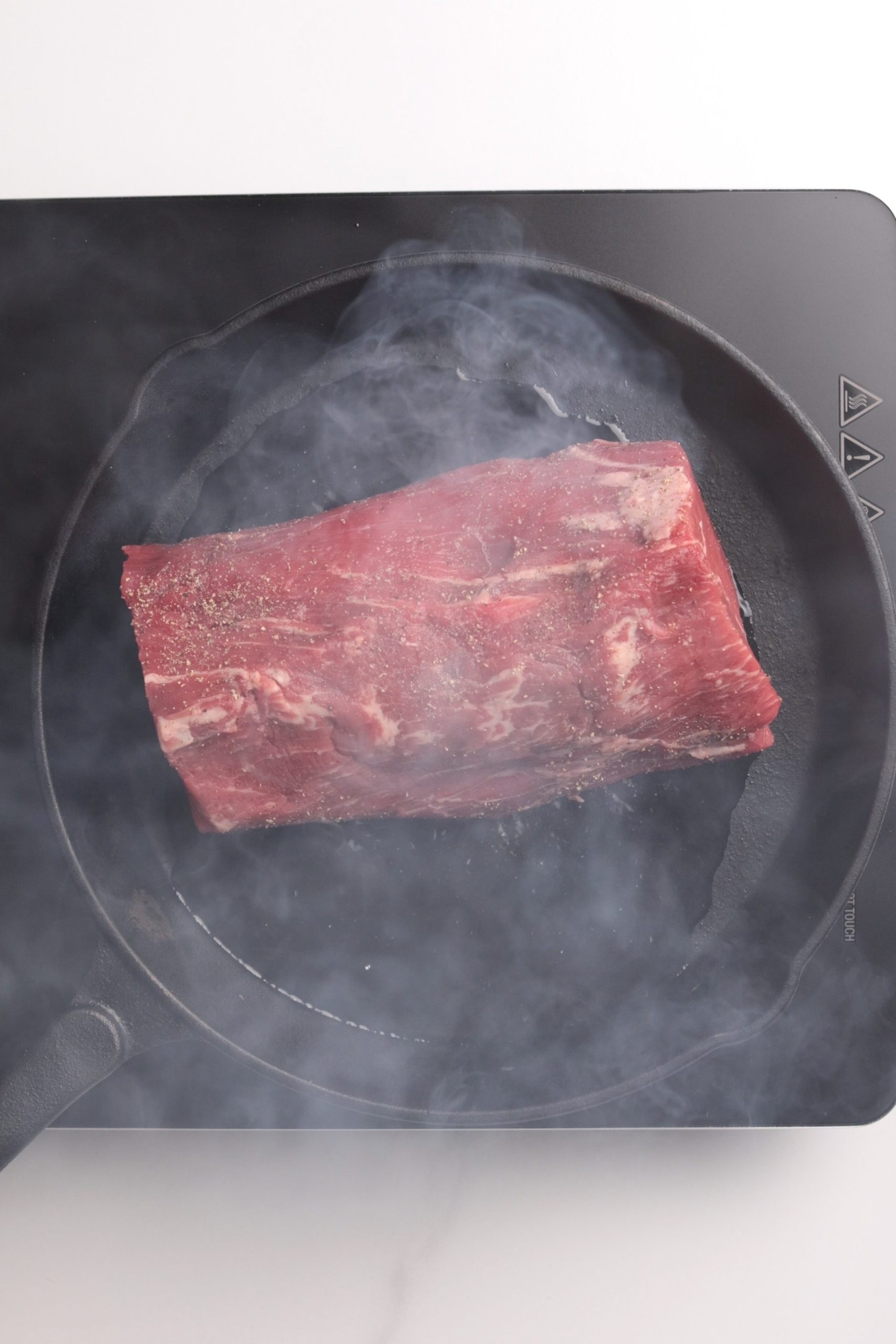
- Sear: Heat the neutral oil in a heavy skillet over high heat. Brown the beef for 1–2 minutes per side, briefly searing both ends too. You’re browning the outside, not cooking the center.
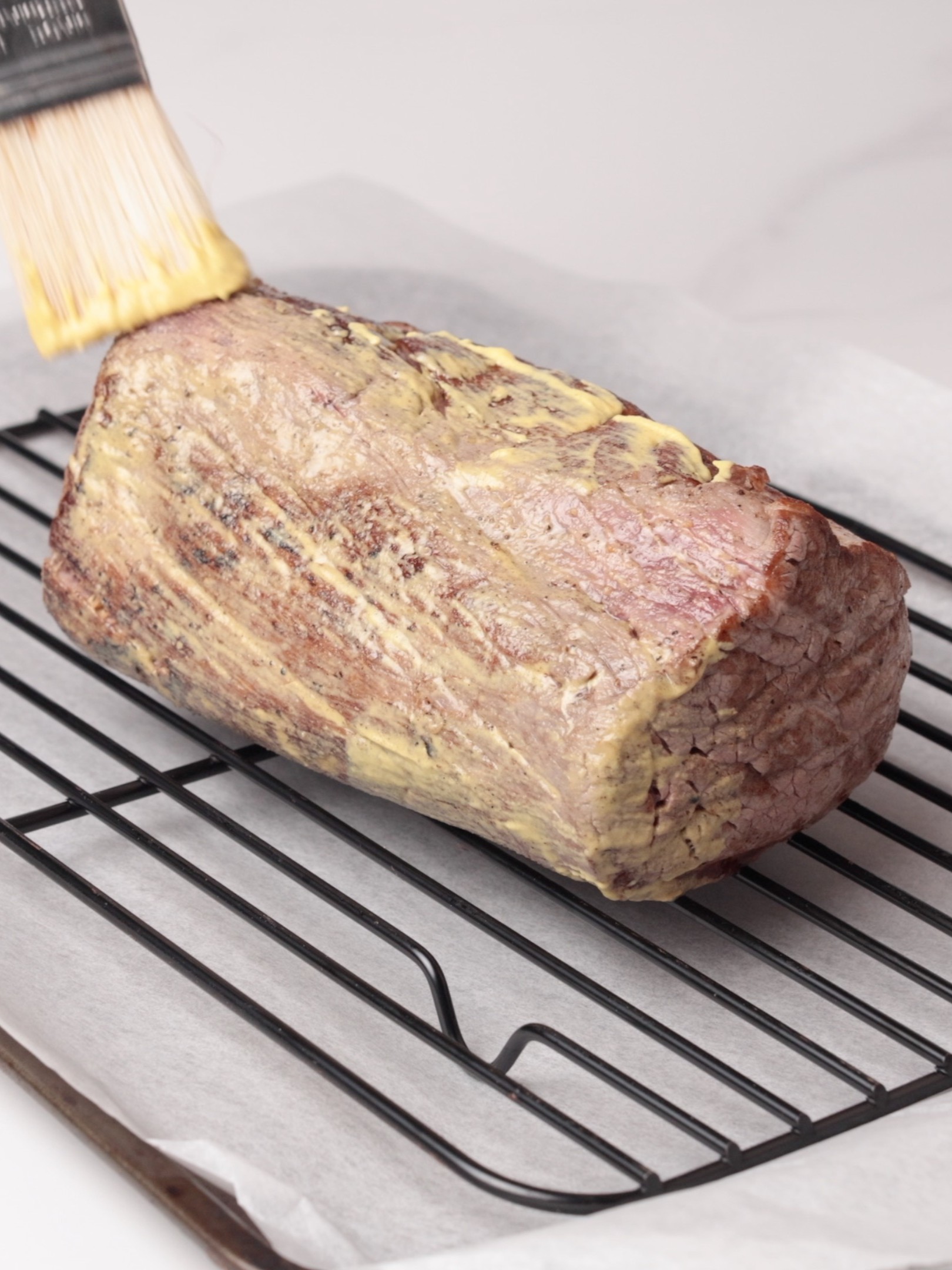
- Brush and chill: Transfer to a wire rack, remove any twine and immediately brush all over with Dijon mustard. Refrigerate until completely cold before wrapping.
Make the Mushroom Duxelles
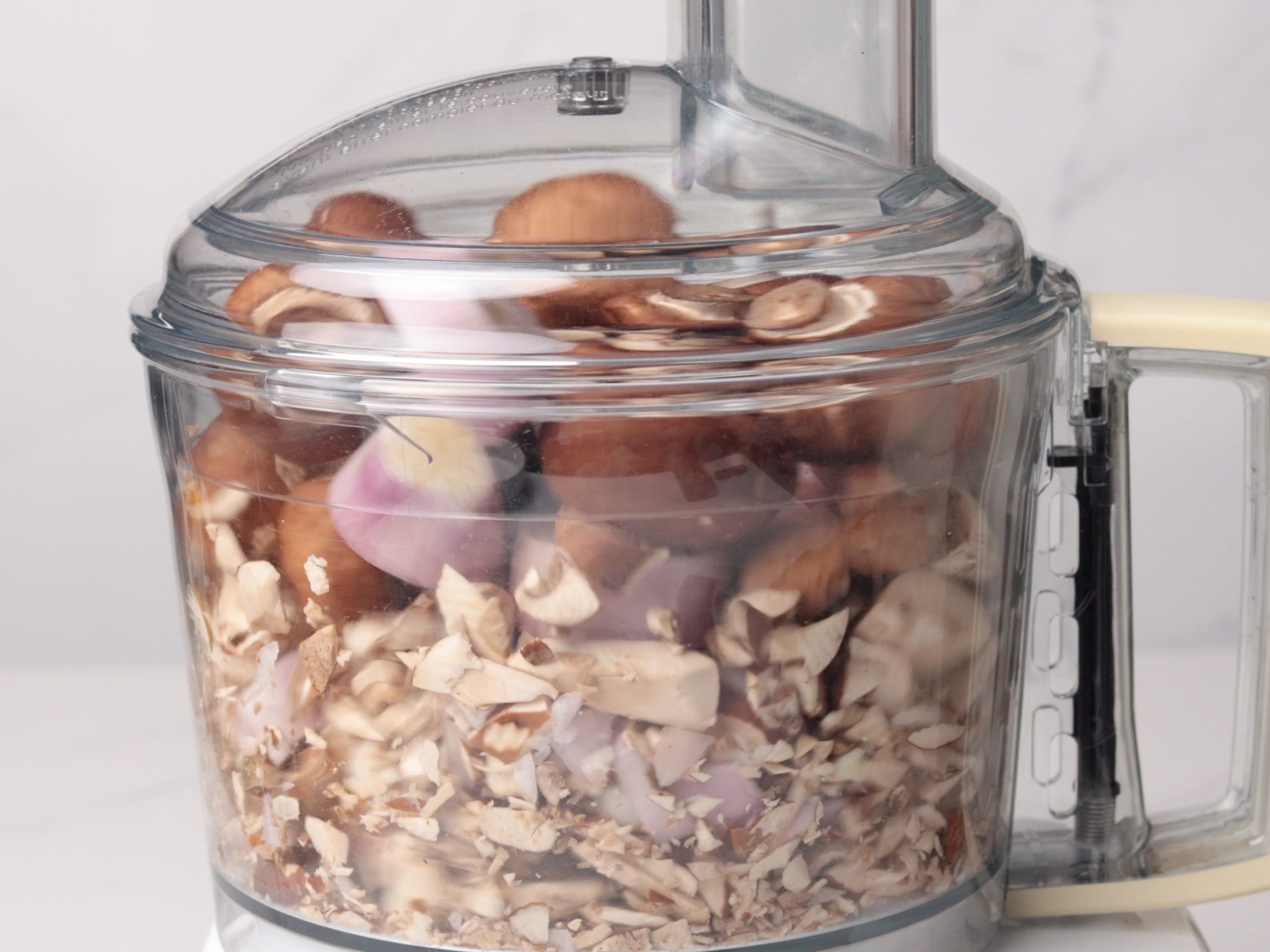
- Chop: Pulse the mushrooms, shallots and garlic in a food processor until very finely chopped. Work in batches if needed and stop before they become a purée.
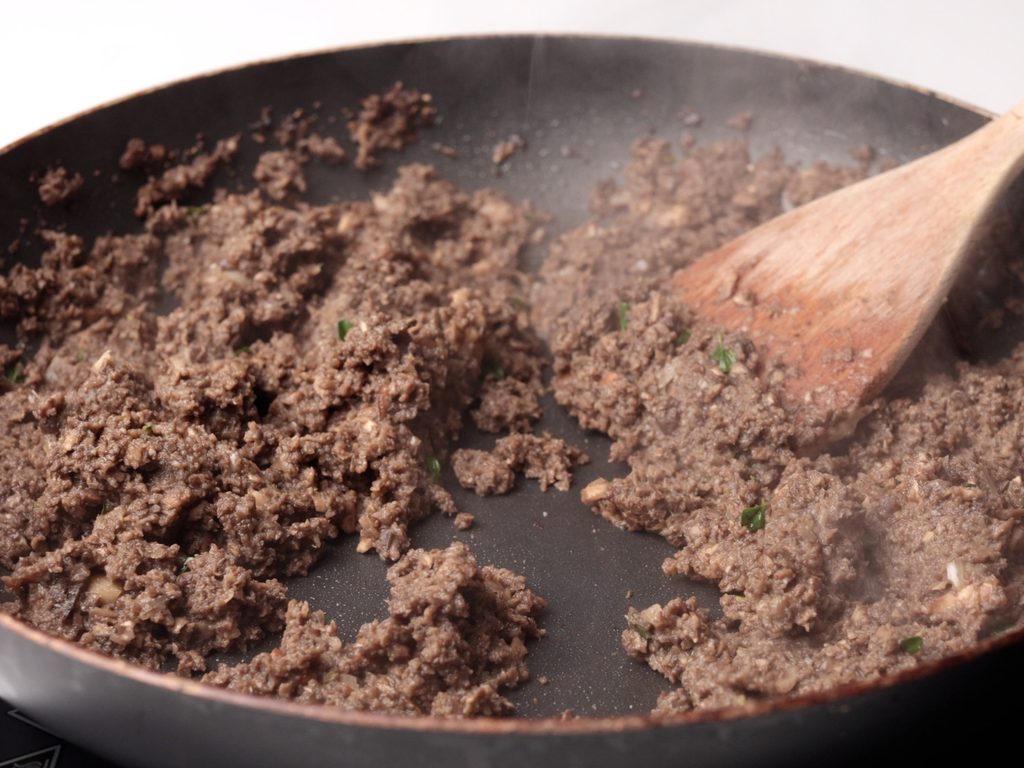
- Cook: Heat the butter and olive oil in a wide skillet over medium-high heat. Add the mushroom mixture, thyme, salt and pepper. Cook, stirring frequently, for 15–20 minutes, then continue as needed.
- Check the texture: The mixture should be very dry and paste-like. Drag a spatula across the pan; if liquid runs into the cleared space, keep cooking. Lower the heat if the mixture starts catching.
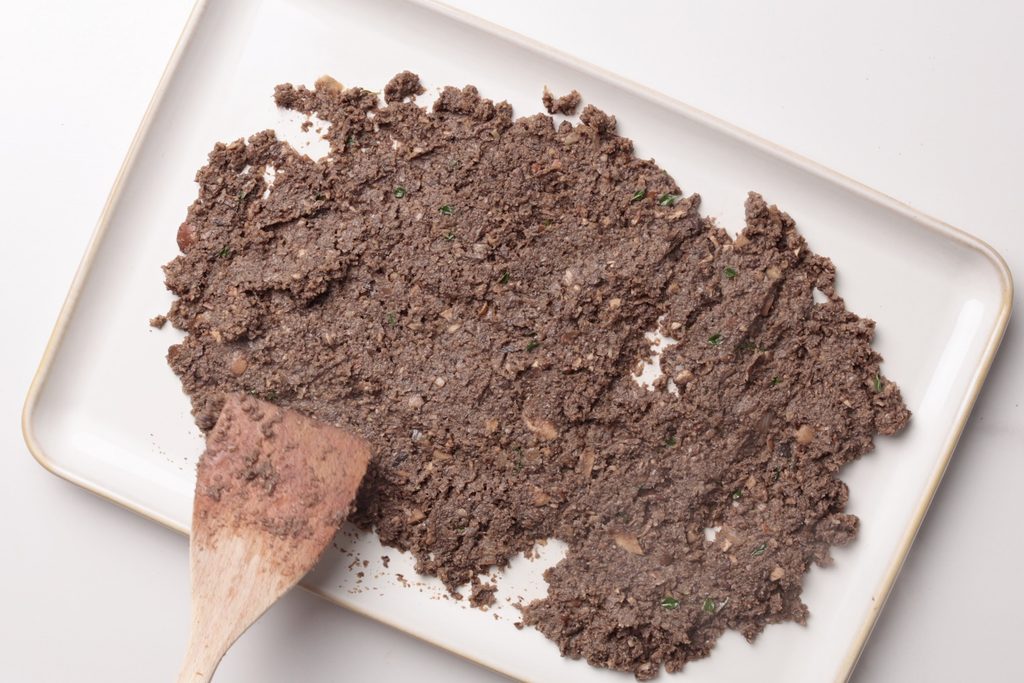
- Chill: Spread thinly on a tray or large plate and refrigerate, uncovered, until completely cold.
Make Thin Crêpes
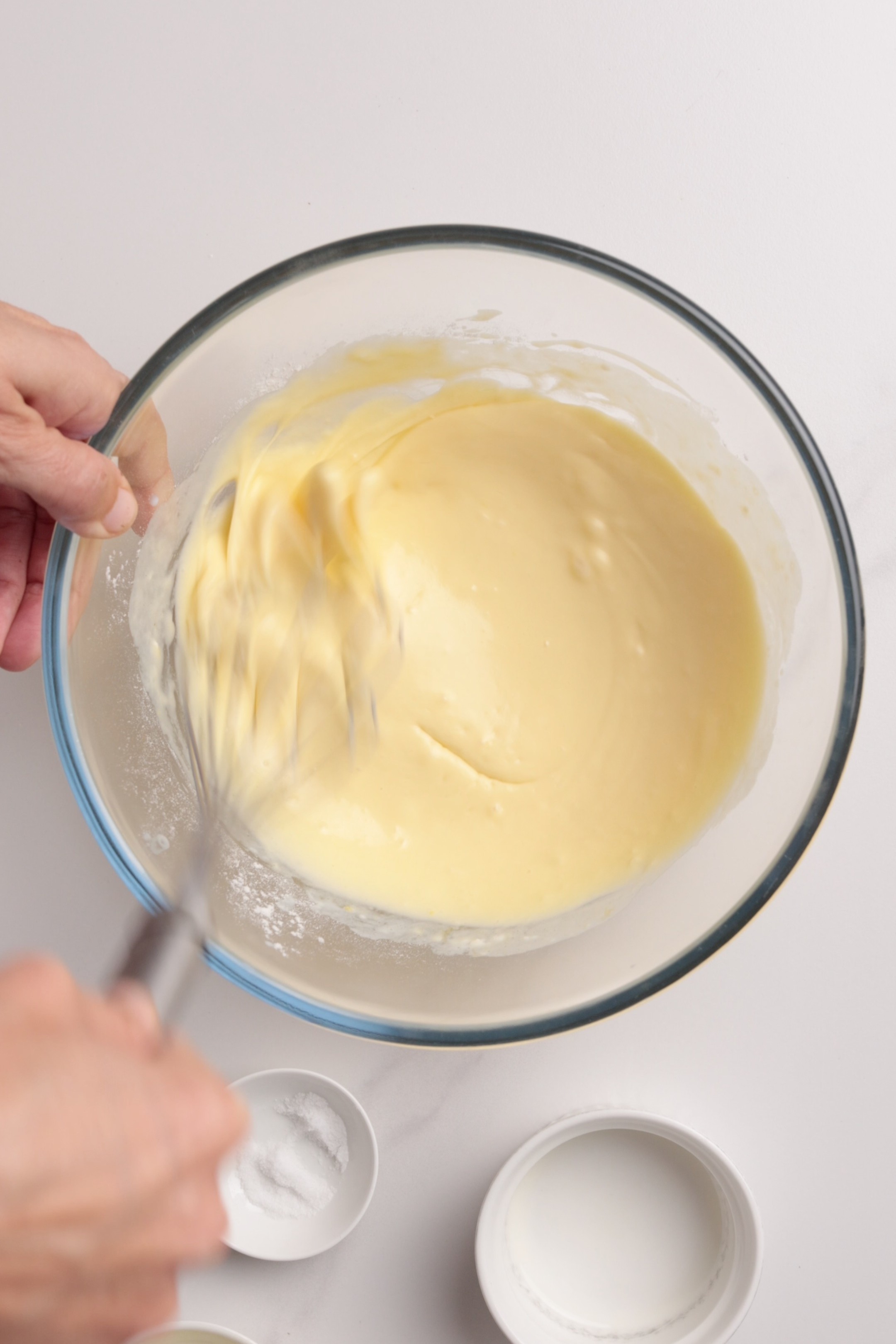
- Mix: Whisk the egg, milk, flour, melted butter and salt until smooth.
- Cook: Lightly grease a nonstick crêpe pan or skillet over medium heat. Pour in just enough batter to coat the base thinly, swirling immediately. Cook for 30–60 seconds, flip and briefly cook the second side.
- Repeat and cool: Continue with the remaining batter; you should get about three thin crêpes. You need enough to enclose the beef with small overlaps; the exact number depends on your pan size and the dimensions of the tenderloin. Refrigerate until completely cool.

New to crêpes? My crêpe-making guide shows the swirling and flipping. Use the savory batter in this Wellington’s recipe card.
How To Assemble Beef Wellington
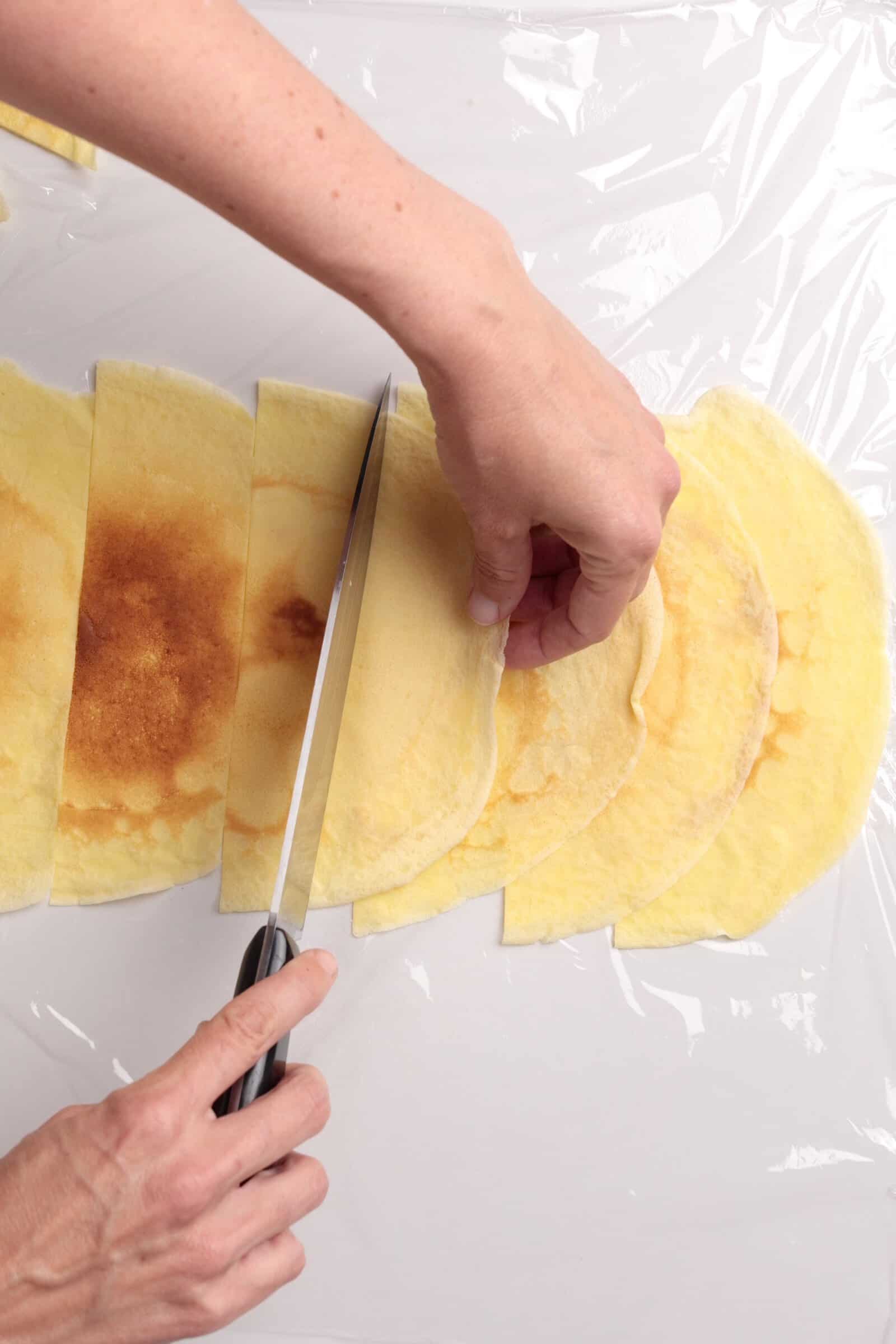
1. Arrange the crêpes: Lay plastic wrap on your work surface. Arrange the cold crêpes into a rectangle large enough to enclose the beef, slightly overlapping every join and trimming where needed.
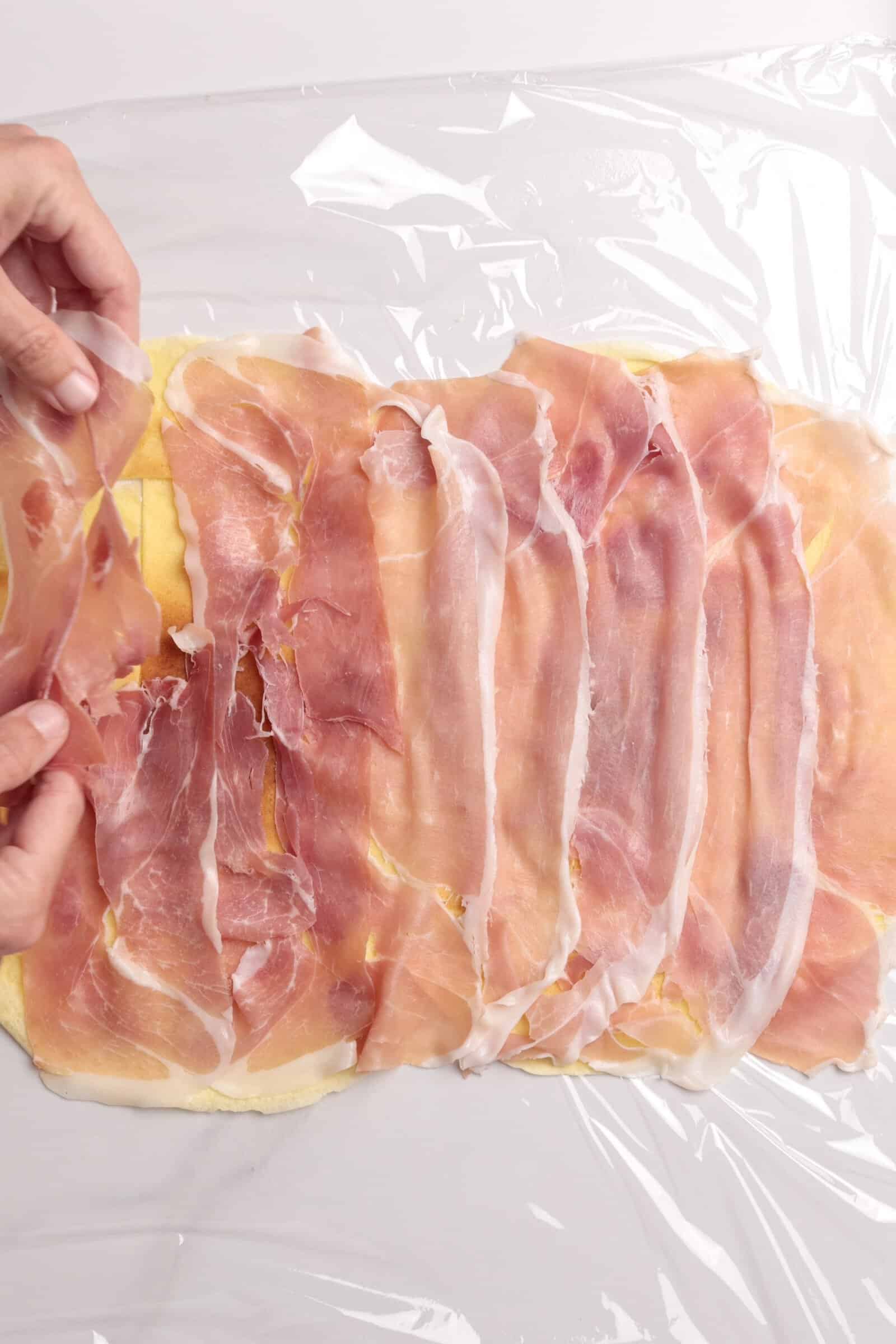
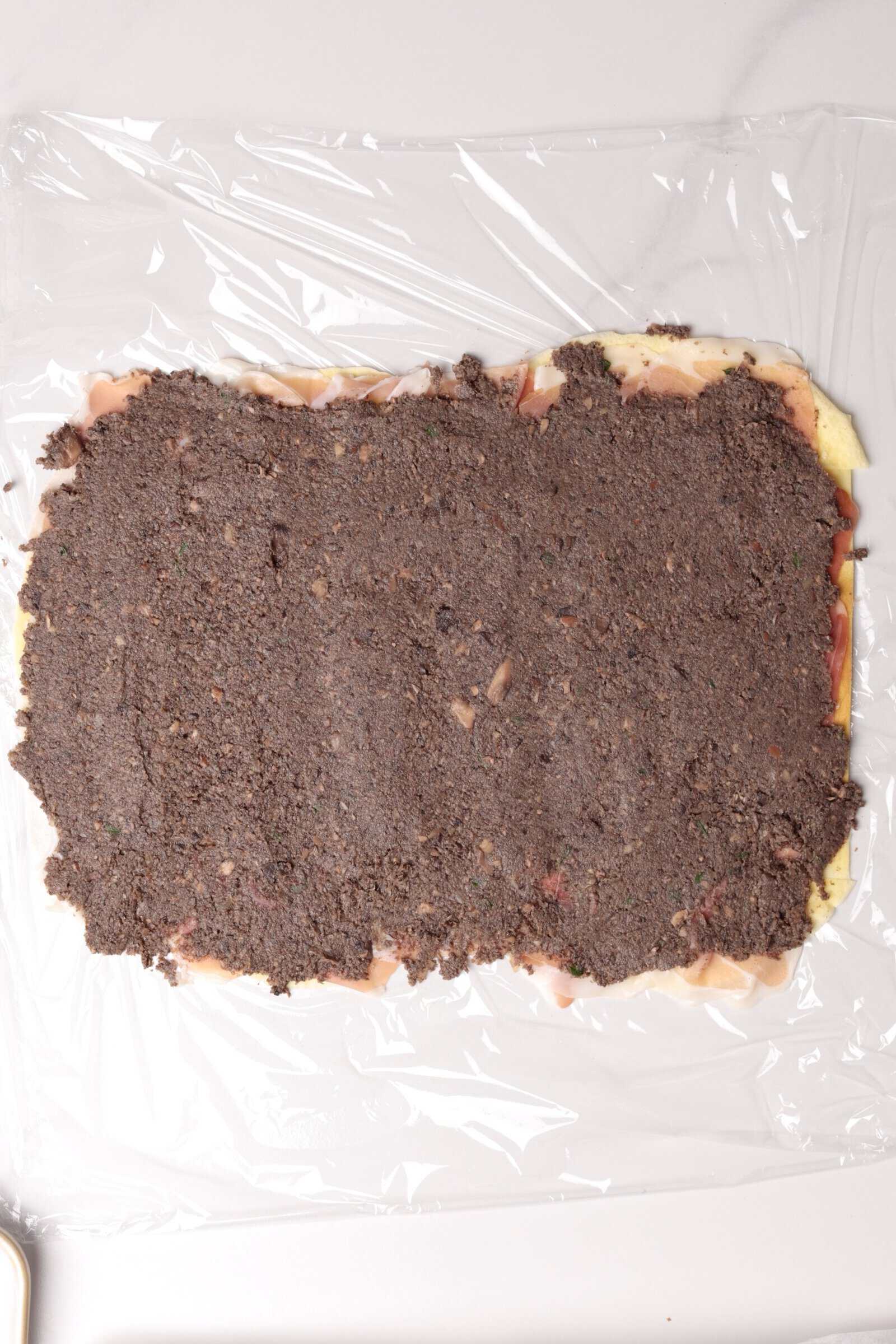
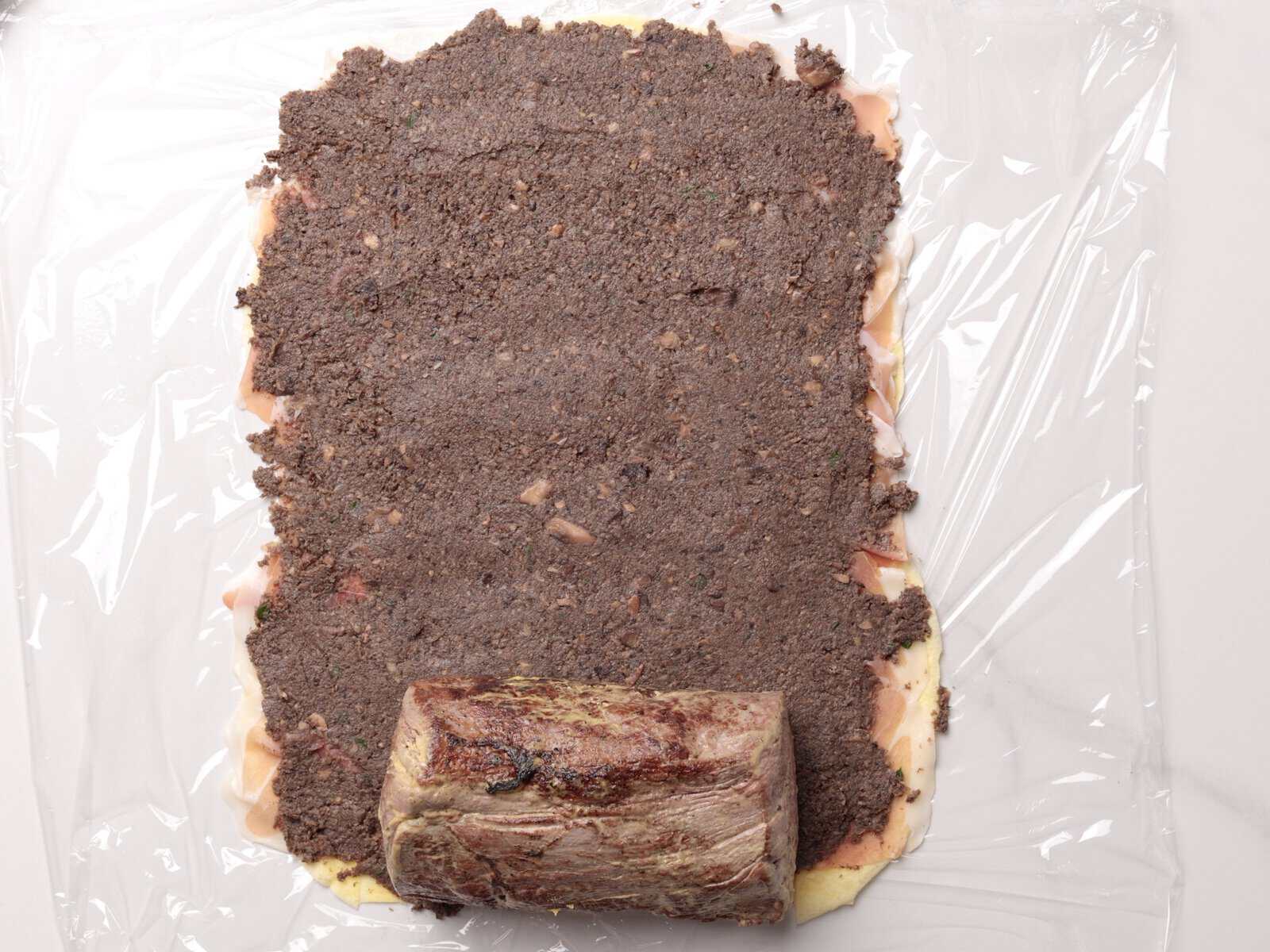
2. Add the filling: Cover with slightly overlapping prosciutto slices, then spread the cold duxelles over them in a thin, even layer. The order is plastic wrap → crêpes → prosciutto → mushrooms, with the beef near the edge closest to you.
3. Roll tightly: Use the plastic wrap to lift and roll the layers snugly around the beef, peeling it back so it stays outside the food. Trim major excess to avoid a thick overlap.
4. Shape and chill: Wrap the cylinder tightly in the plastic and twist the ends like a candy wrapper. Keep it straight and evenly shaped, then refrigerate for at least 30 minutes.
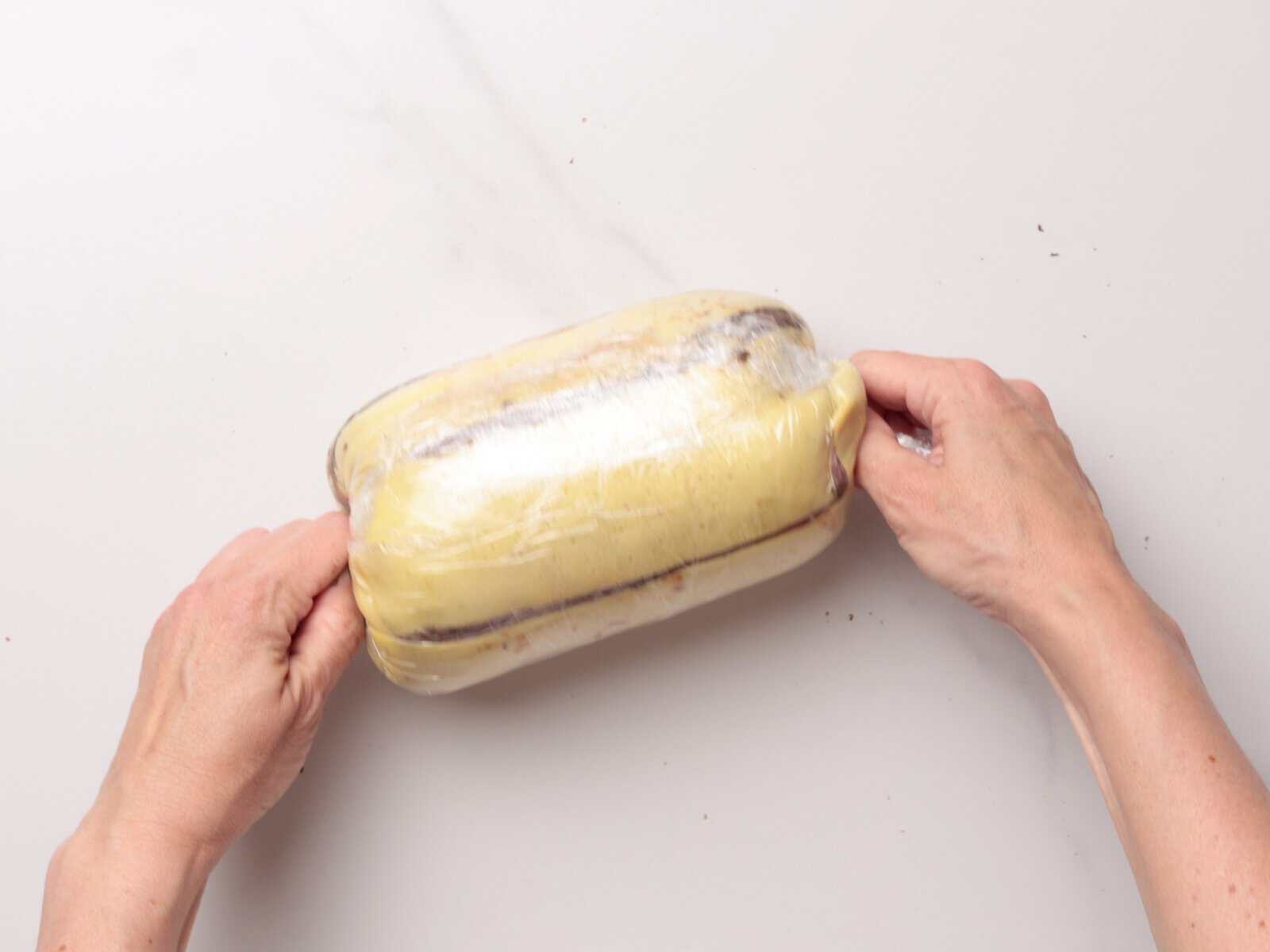
💡 A tip from my testing: I left too little overlap between the crêpes and ended up with small gaps after rolling. Check the joins before adding the prosciutto; it’s much easier to fix them now. Keep the overlaps small so the wrapper stays thin.
Wrap in Puff Pastry
- Roll: Lightly flour your work surface and use a rolling pin to roll the first pastry sheet to ⅛ inch (3mm) thick, large enough to enclose the beef roll. Brush away excess flour.
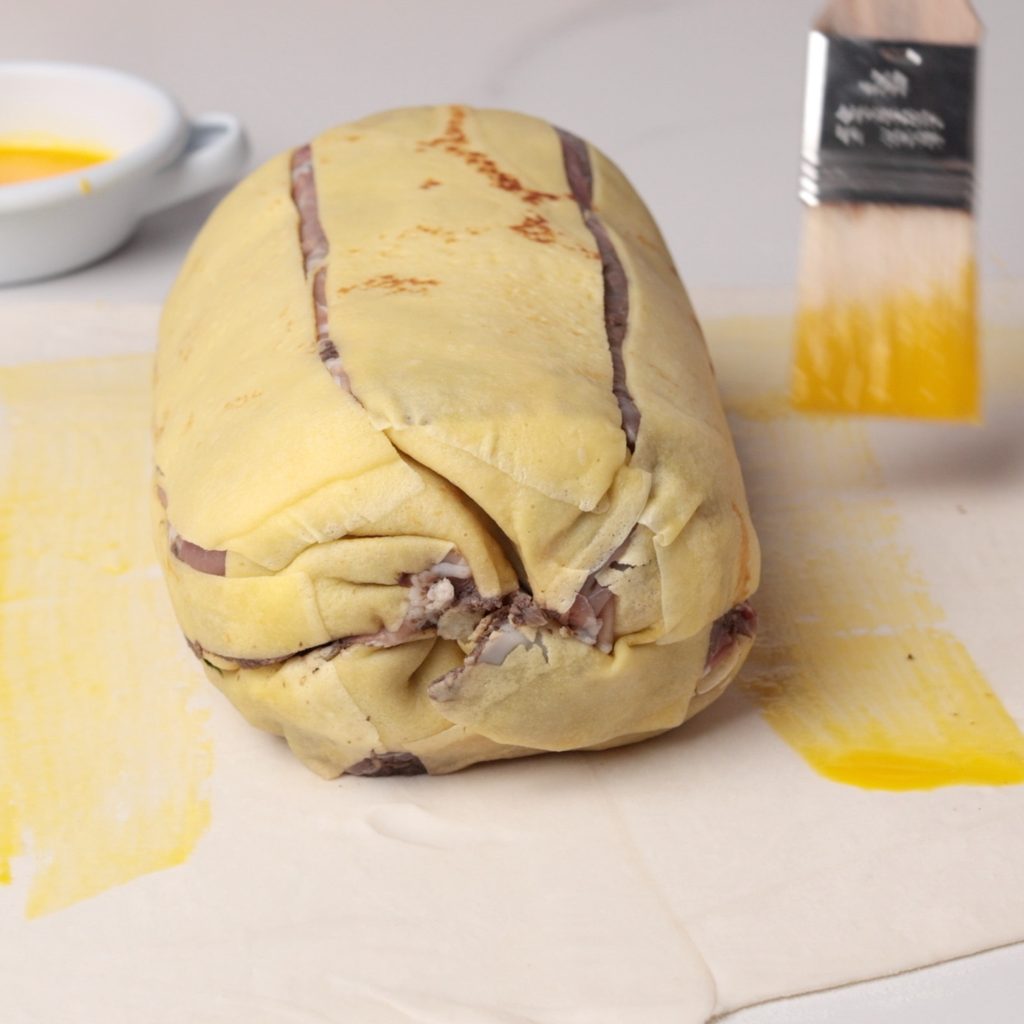
- Position: Whisk the egg yolks with the water or milk. Remove all plastic wrap from the beef and place it in the center of the pastry. Lightly brush the pastry around it with egg wash, particularly where the edges will join.
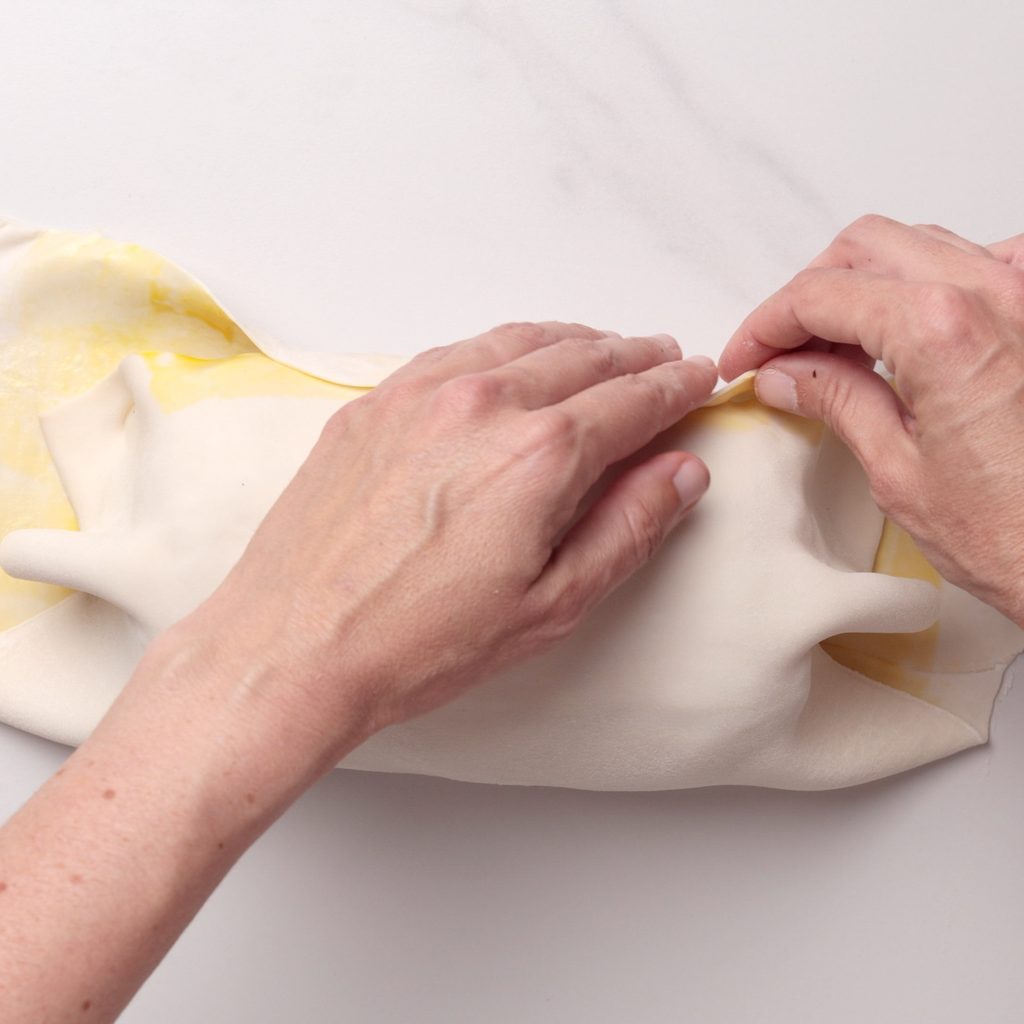
- Seal: Bring one side over the beef, followed by the opposite side. Trim excess, leaving enough overlap to seal. Fold the ends neatly, brushing joining edges with egg wash before pressing together. Avoid bulky folds that can stay doughy.
- Chill: Place seam-side down on a parchment-lined baking sheet and refrigerate while preparing the lattice.
How to Make a Lattice for Beef Wellington
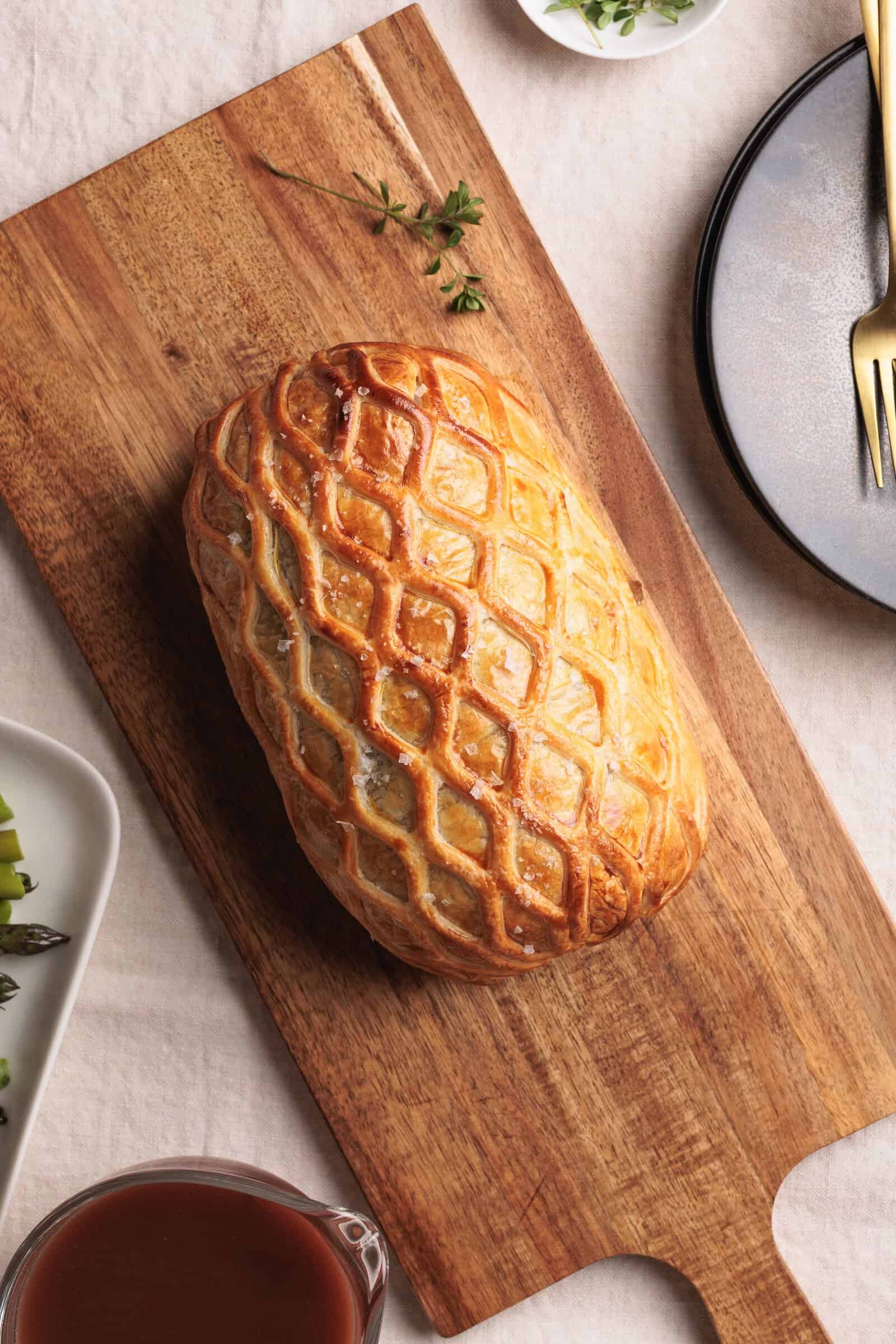
The lattice is optional, but I highly recommend it for a festive presentation. A lattice cutter makes the pattern much easier to create.
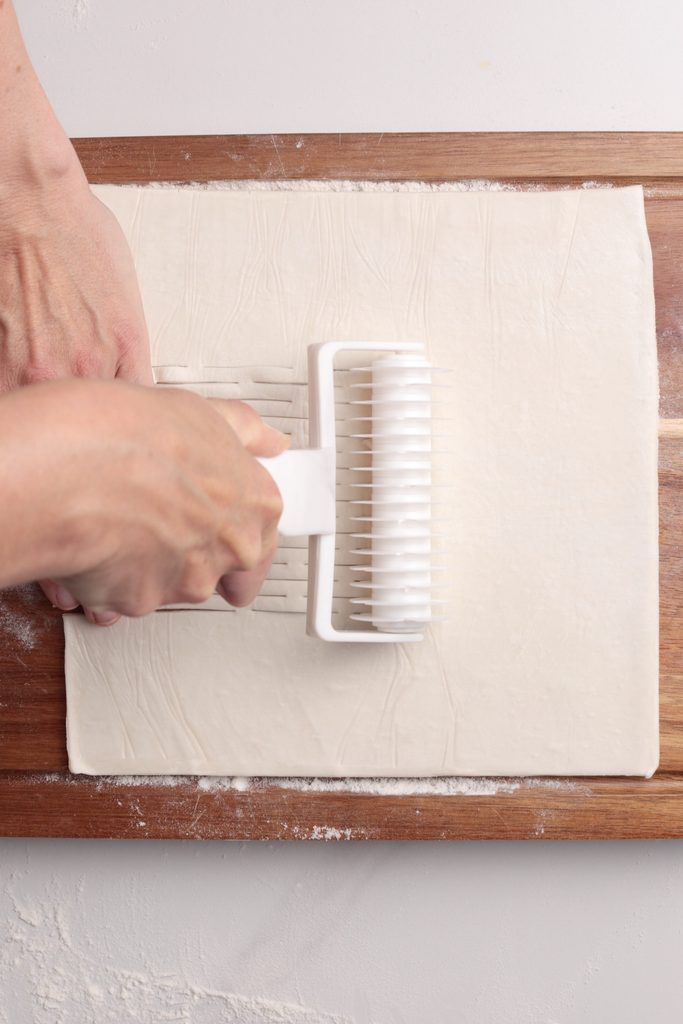
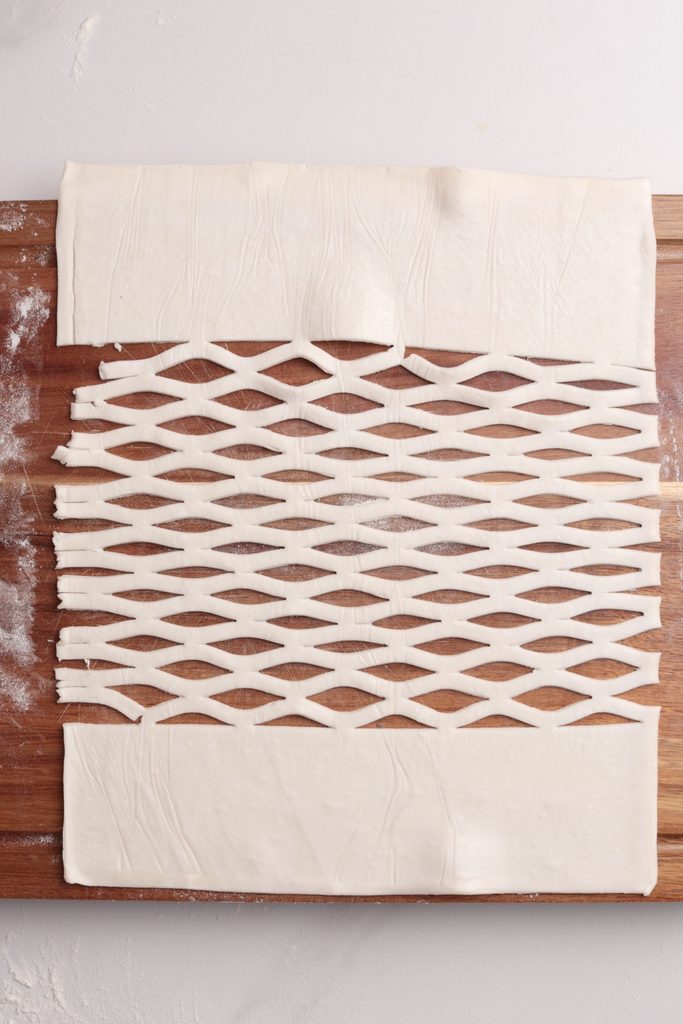
1. Cut: Roll the second pastry sheet to ⅛ inch (3mm) thick. Run the lattice cutter over it with even pressure so the cuts go through.
2. Open: Gently stretch the pattern. If any cuts haven’t opened, finish them with the tip of a small knife rather than pulling harder.
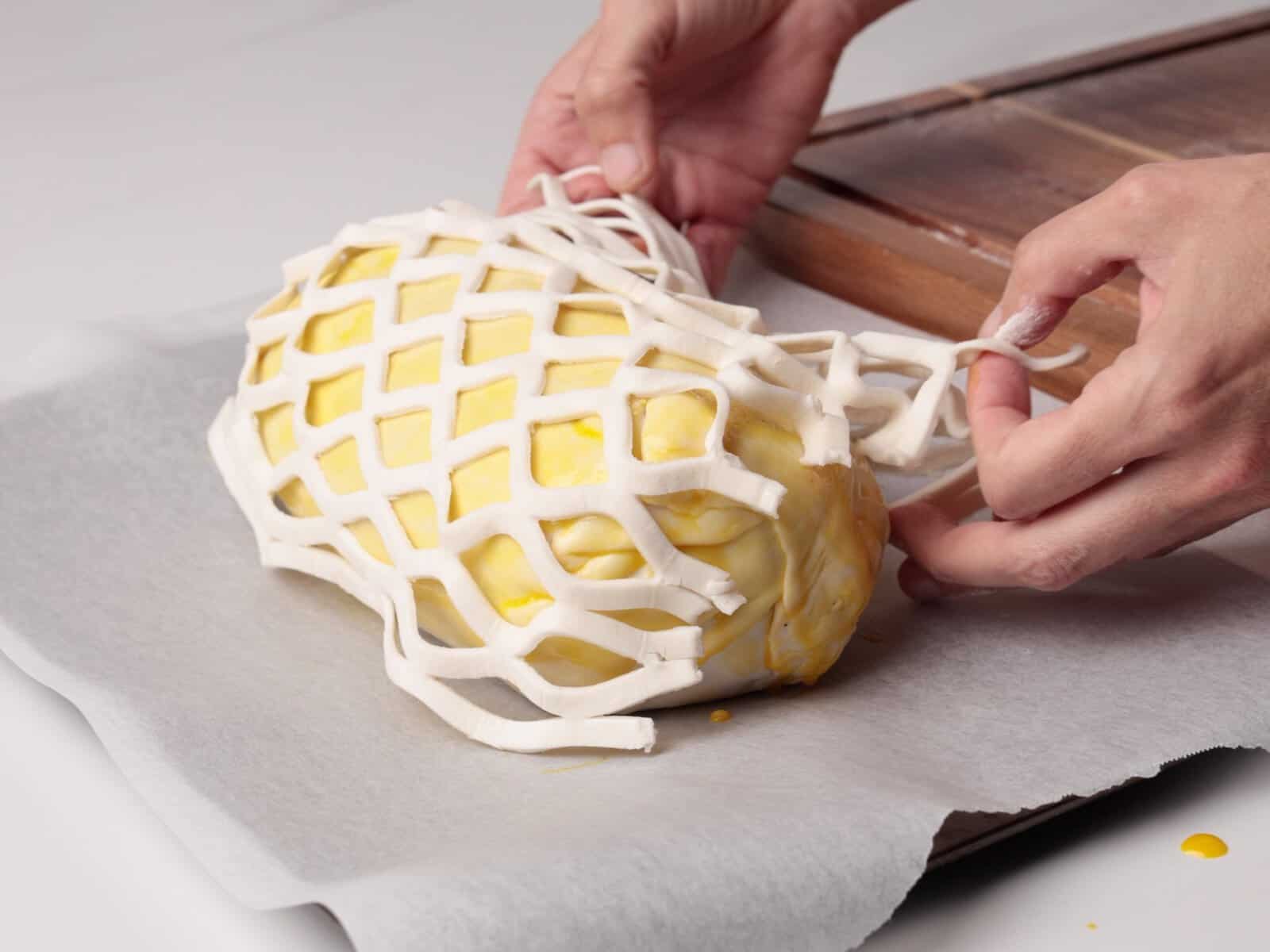
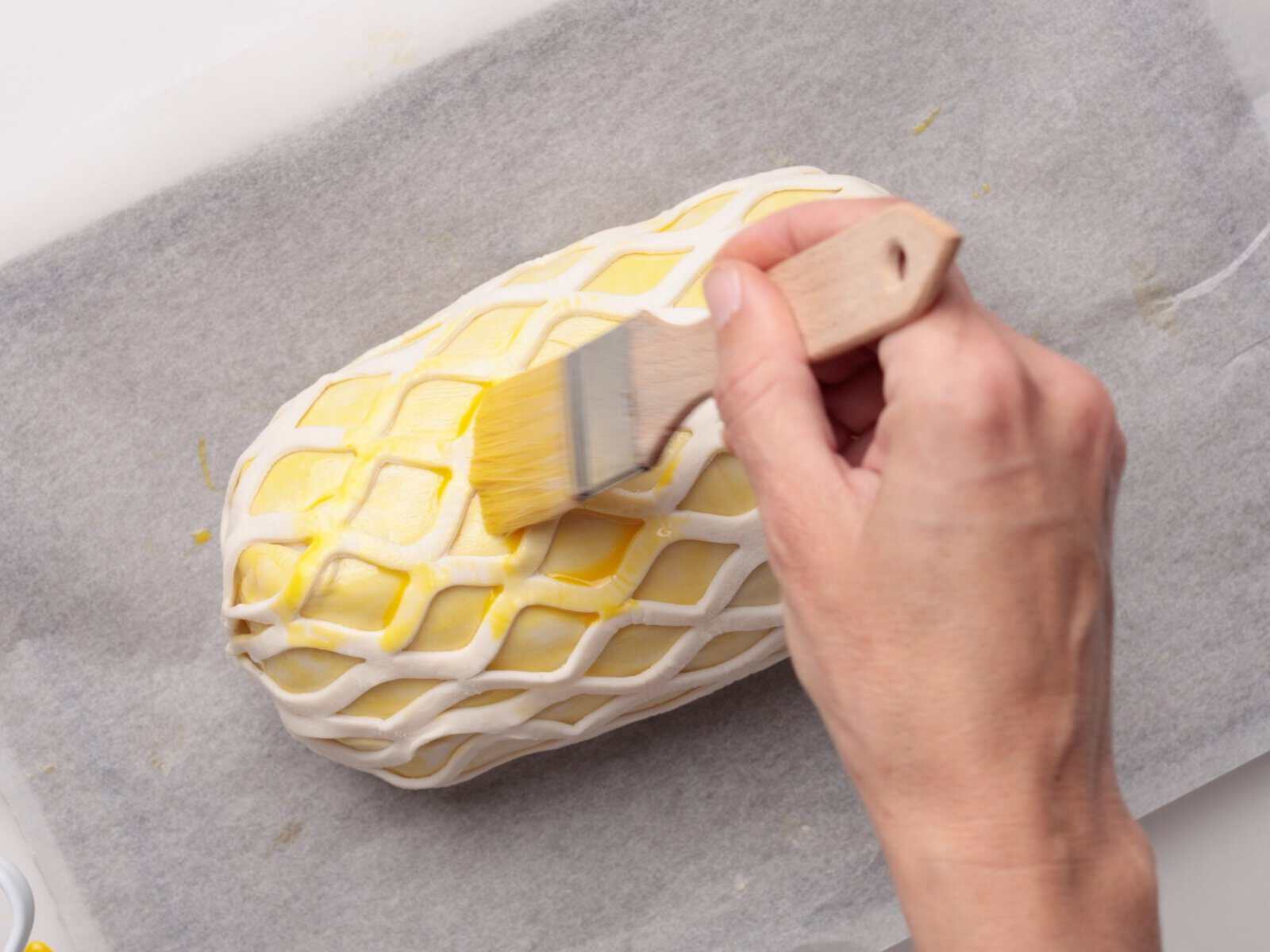
3. Attach: Lightly egg-wash the chilled Wellington, drape the lattice over it and center the pattern. Press gently to attach, trim around the bottom and brush with another thin layer of egg wash.
4. Chill again: Refrigerate for 15–20 minutes while the oven preheats. If the pastry becomes soft or greasy during decorating, chill it before continuing.
💡 Skipping the lattice? Lightly egg-wash the plain pastry, then leave it smooth or gently mark a pattern with the back of a knife without cutting through. Follow the same final chilling step.
Bake and Check the Center
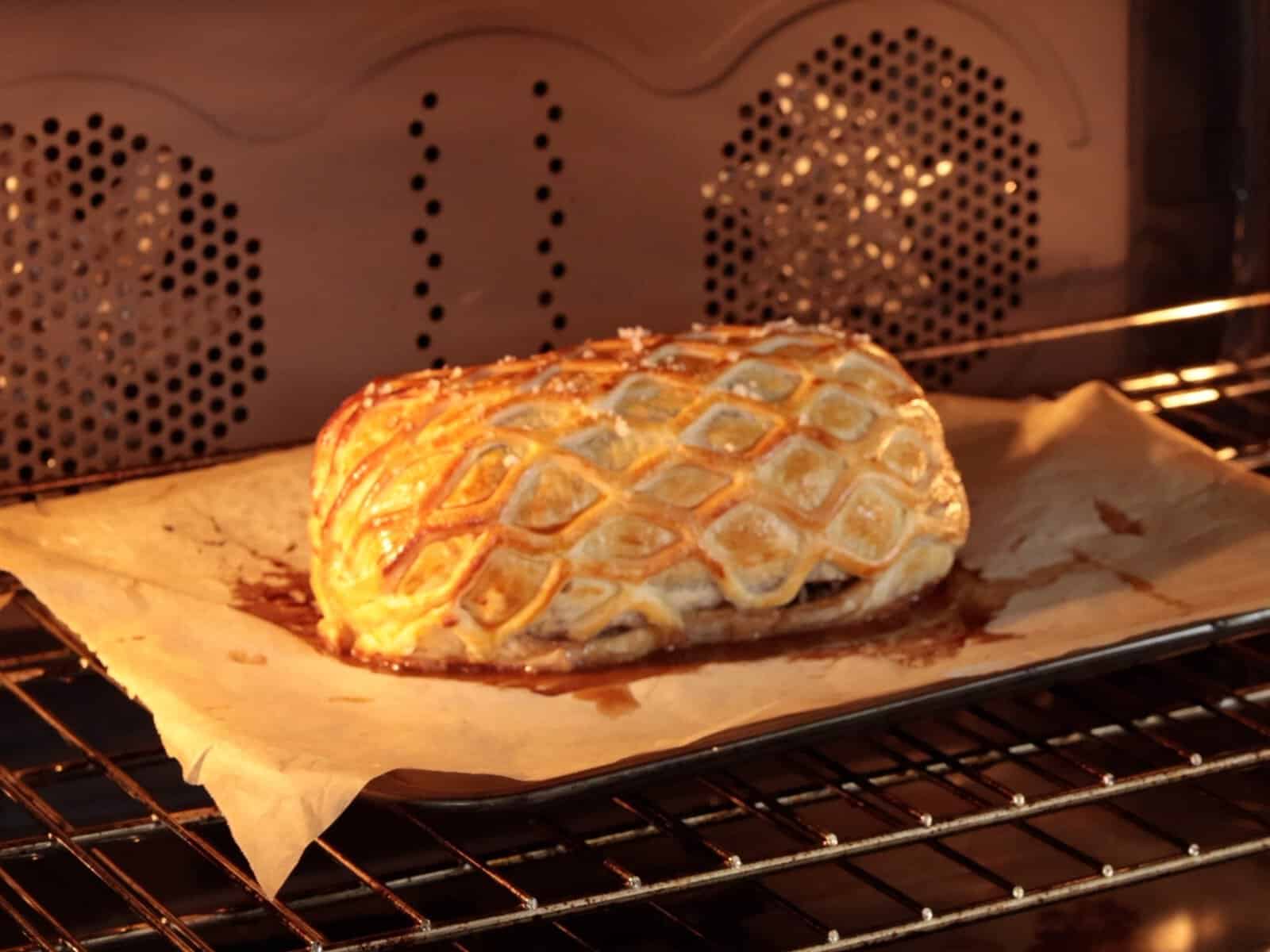
- Bake: Preheat the oven to 400°F (200°C). Sprinkle the cold Wellington lightly with flaky sea salt and bake for approximately 35–45 minutes, until the pastry is deeply golden and crisp. A thicker piece of beef may take longer.
- Check the beef: Toward the lower end of the baking time, insert a meat thermometer horizontally through one end, aiming for the very center of the beef rather than the mushrooms. Use the temperature guide below.
- Protect the pastry: If it becomes deeply browned before the beef reaches your target temperature, loosely tent the top with foil and continue baking, checking the center regularly.
| Desired result | Approximate temperature when removing from the oven |
|---|---|
| Medium-rare target | 125–130°F (52–54°C) |
| Medium target | 130–135°F (54–57°C) |
These are culinary pull temperatures. The beef continues cooking during the rest, and the amount of temperature rise varies.
Food-safety note: USDA recommends cooking whole cuts of beef to 145°F (63°C) before removing them from the heat, followed by at least a 3-minute rest. The pink-center targets above are below that recommendation.
Rest and Slice
- Rest: Leave the Wellington for 15–20 minutes before slicing. Avoid covering it tightly, which can soften the pastry.
- Slice and serve: Use a sharp slicing or serrated knife with a gentle sawing motion to cut thick slices without crushing the crust. Serve promptly.
Essential Tools
This post contains affiliate links. As an Amazon Associate, I earn from qualifying purchases.
- Meat thermometer: This is the tool I most strongly recommend. Pastry color cannot tell you whether the beef is ready.
- Large, heavy skillet: For browning the beef and cooking the mushrooms. A wide surface helps the duxelles dry out.
- Nonstick crêpe pan: For making thin crêpes that release easily.
- Food processor, helpful but optional: It makes finely chopping the mushrooms much quicker. A sharp knife works too.
- Lattice cutter: You can make the Wellington without it, but I highly recommend the lattice for a festive presentation.
Troubleshooting Beef Wellington
Moist duxelles, warm filling and thick pastry overlaps can all contribute. Cook the mushrooms until no liquid collects in the pan, cool every component fully and keep the bottom seam thin. The crêpes help, but they cannot compensate for wet mushrooms.
The pastry may be too thick, especially at the ends and seam, or the beef may be too thin for the pastry’s baking time. Choose an evenly thick center cut, roll the pastry to about 3mm and fully preheat the oven. Continuing to bake will also continue cooking the beef.
A loose wrap, thick uneven filling or slicing too soon can make neat portions harder. Keep the layers thin and snug, chill the wrapped cylinder and give the baked Wellington its full rest.
How to Serve Beef Wellington
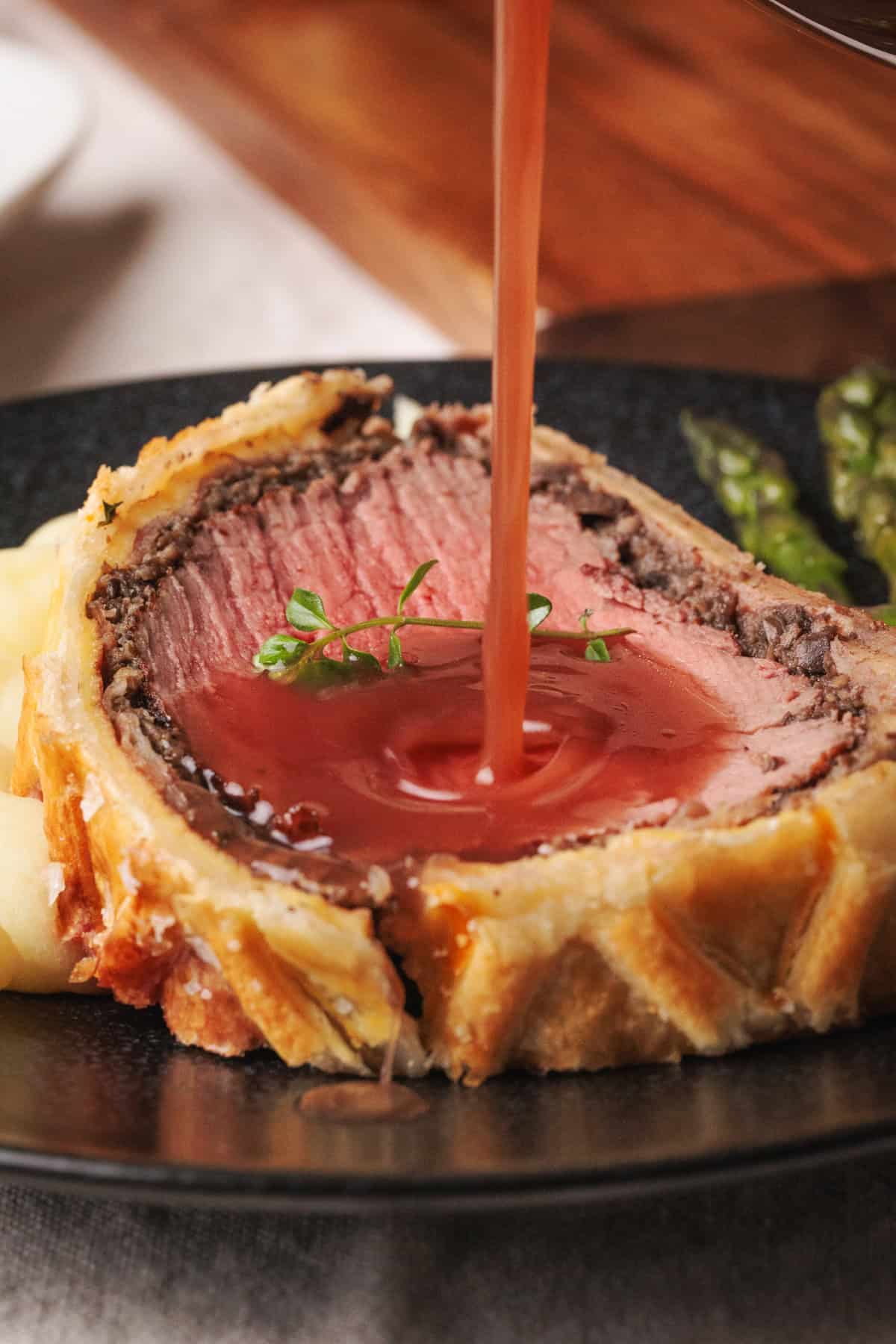
Serve with the red wine sauce in the recipe card below. It’s a glossy, reduced, jus-style sauce rather than a thick gravy. Start it while the Wellington bakes so there’s time for both reductions, and whisk in the cold butter off the heat shortly before serving.
Spoon the sauce beside or beneath each slice rather than pouring it over the crisp pastry.
For sides, choose one potato dish and something green:
- Creamy mashed potatoes are a simple choice with the red wine sauce.
- Hasselback potatoes or Parmesan smashed potatoes add crisp edges; scalloped potatoes make a richer alternative.
- A fresh kale salad, steamed green beans or asparagus balances the beef and buttery pastry.
For dessert, my sticky toffee pudding makes a lovely finish to a winter dinner.
Plan oven-baked sides around the Wellington rather than changing its oven temperature to suit them.
Make Ahead, Storage and Reheating
- The day before: Make the duxelles and crêpes, cool them promptly, then cover and refrigerate separately. Thaw frozen puff pastry according to its package instructions. Plan the beef preparation, assembly and baking for serving day.
- Leftovers: Refrigerate in a shallow, covered container within 2 hours and use within 3–4 days, keeping the refrigerator at 40°F (4°C) or below. The pastry is at its best freshly baked.
- Reheating: Use a 325°F (165°C) oven and reheat leftovers to 165°F (74°C) in the center, loosely shielding the top if necessary. This cooks the beef further, so don’t expect the original pink center. The microwave is quicker but softens the pastry.
FAQs
Tenderloin gives the most tender result. Sirloin and striploin can work in adapted Wellington recipes, but they have a firmer texture and need their own cooking guidance. See “Choose the Right Cut” above.
Some Wellington recipes don’t use them, but they’re part of the version I tested. For your first attempt, I recommend keeping them and making them very thin.
Individual portions need different wrapping quantities and baking times. I wouldn’t divide this roast and assume the same instructions will give the same result.
For this recipe, I recommend preparing the duxelles and crêpes ahead, then assembling and baking the Wellington fresh. That keeps the preparation manageable without relying on untested freezing and baking times.
More Recipes for a Special Dinner
Best Beef Wellington Recipe
Ingredients
For the beef:
- 2 pounds (900 g) Beef tenderloin center-cut *see notes
- 1 teaspoon Salt or just enough to season to whole cut
- ¾ teaspoon Pepper freshly ground
- 2 tablespoons Neutral oil
- 2 tablespoons Dijon Mustard or just enough to cover
For the mushroom Duxelles:
- 1½ pounds (680 g) Cremini/chestnut mushrooms *see notes
- 2 Shallots roughly chopped
- 2 cloves Garlic
- 2 tablespoons Butter Unsalted
- 1 tablespoon Olive oil
- 1 tablespoon Fresh thyme leaves
- ½ teaspoon Salt or to taste
- ¼ teaspoon Black pepper
For the crepes:
- 1 Egg large
- ½ cup (120 ml) Whole milk
- ½ cup (62 g) All-purpose flour
- 1 tablespoon (15 g) Unsalted butter melted
- Pinch salt
- 1 teaspoon Butter or oil, for the pan
For Assembly:
- 8-10 Prosciutto thin slices
- 1½ pounds (680 g) All-butter puff pastry divided (two sheets), thawed but cold
- 1 tablespoon All-purpose flour for rolling
- 2 Egg yolks
- 1 tablespoon Water or milk
- Flaky sea salt
For the Red Wine Sauce (optional):
- 1 tablespoon Butter Unsalted
- 1 Shallot finely chopped
- 1 cup (240 ml) Dry red wine
- 2 cups (480 ml) Beef stock good-quality
- 2 sprigs fresh Thyme
- 1 tablespoon Unsalted butter cold *or more if needed
- Salt and to taste
- Black pepper to taste
Instructions
- Sear the beef: Pat the beef completely dry and season generously on all sides with salt and pepper. Heat the oil in a cast-iron or heavy skillet over high heat. Once very hot, add the beef and sear until deeply browned on all sides, about 1–2 minutes per side. Sear the two ends briefly as well. You are only developing a crust at this stage, not cooking the beef through.
- Transfer to a wire rack and immediately brush the entire surface with Dijon mustard. Refrigerate until completely cold.
- Make the mushroom duxelles: Add the mushrooms, shallots and garlic to a food processor and pulse until very finely chopped. Do not process into a purée.
- Melt the butter with the olive oil in a large skillet over medium-high heat. Add the mushroom mixture, thyme, salt and pepper.
- Cook, stirring frequently, until the mushrooms release their moisture and all of the liquid has evaporated, about 15–20 minutes. Continue cooking for another few minutes until the mixture is very dry and paste-like.
- Spread onto a tray or large plate in a thin layer and refrigerate, uncovered, until completely cold.
- Make the crêpes: Whisk together the egg, milk, flour, melted butter and salt until smooth.
- Lightly grease a nonstick skillet and heat over medium heat. Pour in just enough batter to make a very thin crêpe, swirling the pan to spread it evenly. Cook for about 30–60 seconds, flip and cook briefly on the second side. Repeat with the remaining batter. You should have about 3 thin crêpes.
- Transfer to a plate and refrigerate until completely cool.
- Wrap the beef: Lay a large sheet of plastic wrap on your work surface. Arrange the cold crêpes in a rectangle slightly wider and longer than the beef, overlapping them slightly and trimming as needed to create one thin, even layer without any gaps.
- Arrange the prosciutto over the crêpes in slightly overlapping slices, completely covering the crêpes. Spread the cold duxelles over the prosciutto in a thin, even layer, spreading it all the way to the edges.
- Place the chilled beef along the bottom edge. Using the plastic wrap to help you, roll everything tightly around the beef, keeping the layers snug against the meat. Once the outer layers meet, trim away any major excess to avoid creating a thick overlap.
- Wrap the cylinder tightly in the plastic wrap and twist both ends firmly, almost like a candy wrapper, to compress the Wellington. As you tighten it, make sure the beef holds a neat, straight and evenly shaped cylinder from end to end; this is important for even cooking and clean, uniform slices. Refrigerate for at least 30 minutes, or overnight.
- Wrap in puff pastry: Lightly flour your work surface and roll out the first sheet of puff pastry to about ⅛-inch (3mm) thick, making sure it is large enough to completely enclose the beef. Brush away any excess flour.
- Whisk the egg yolks with 1 tablespoon water or milk. Unwrap the chilled beef and place it in the center of the pastry. Brush the pastry lightly with egg wash around the beef and especially along the edges and areas that will overlap and form the seams. You don’t need to flood the pastry; a thin layer is enough.
- Bring one side of the pastry tightly over the beef, followed by the opposite side. Press gently to seal, then trim away the excess pastry, leaving just enough overlap to create a secure seam. Fold in the ends neatly, trimming away excess pastry as needed. Brush the edges with egg wash before pressing them together to seal. Avoid thick folds or excessive overlapping pastry, which can remain underbaked.
- Place the Wellington seam-side down on a parchment-lined baking sheet. Gently shape it with your hands if necessary to maintain a neat, even cylinder. Refrigerate while you prepare the lattice.
- Make the lattice: On a lightly floured surface, roll the remaining puff pastry to approximately ⅛-inch (3mm) thick. Run a lattice cutter evenly over the pastry, applying consistent pressure so the cuts go through the pastry.
- Carefully begin opening the lattice by gently stretching it with your hands. Work slowly and evenly so you don’t tear or distort the pattern. If some of the cuts haven’t opened completely, use the tip of a small sharp knife to carefully finish/open each cut before stretching the lattice further. Don’t force the pastry apart.
- Brush the chilled Wellington lightly with egg wash, then carefully drape the lattice over the top. Gently adjust it until the pattern is centered and evenly opened, then press it lightly against the pastry underneath. Trim away the excess around the bottom. Brush the entire Wellington, including the lattice, with another thin, even layer of egg wash.
- Refrigerate for 15–20 minutes while the oven preheats.
- Bake: Preheat the oven to 400°F (200°C). Sprinkle the chilled Wellington lightly with flaky sea salt.
- Bake for approximately 35–45 minutes, or until the pastry is deeply golden and crisp and the beef has reached your desired internal temperature. Start checking the temperature toward the lower end of the baking time.
- Rest for 15–20 minutes before slicing.
- Make the red wine sauce: While the Wellington rests, melt 1 tablespoon butter in a saucepan over medium heat. Add the shallot and cook for 2–3 minutes, until softened. Add the red wine and thyme and bring to a simmer. Cook until the wine has reduced by roughly two-thirds. Add the beef stock and simmer until reduced to a rich, concentrated sauce, about 10–15 minutes, depending on your stock and pan.
- Strain the sauce and return it to the pan. Continue simmering for another minute or two if needed, until it reaches your desired consistency. Remove from the heat and whisk in 1 tablespoon cold butter until glossy and emulsified. Taste and season with salt and pepper as needed.
- Serve: Using a sharp serrated or slicing knife, cut the Wellington into thick slices. Serve immediately with the warm red wine sauce.
Video
Notes
- Beef note: Beef size: Use 900–1,200g (about 2–2⅔ pounds) trimmed, center-cut beef tenderloin. Choose an evenly thick piece rather than a tapered tail. Thickness and starting temperature affect cooking time more than weight alone. Use enough crêpes, prosciutto and pastry to enclose your cut in thin, even layers.
- Servings: Allow about 6 servings with a 900g tenderloin, or up to 8 with a 1,200g cut, depending on slice thickness and the sides you serve.
- Don’t skip chilling: Temperature control is one of the keys to a successful Wellington. The beef, duxelles and crêpes should all be completely cold before assembly. Chill again after wrapping the beef and once more after wrapping it in pastry. This helps keep the layers neat and prevents the butter in the puff pastry from melting before baking.
- Duxelles: Cook the mushrooms until they are very dry. If you drag a spatula across the bottom of the pan, you should not see liquid pooling around the mushrooms. Wet duxelles can create soggy pastry.
- Mushrooms: Cremini/chestnut mushrooms are an excellent choice because they have more flavor than standard white button mushrooms. You can also replace a portion with shiitake or other flavorful mushrooms. Or use a combination of 2-3 of your favorite mushrooms.
- Chestnuts: For a festive Christmas version, you can add about ⅓ cup (50–60g) finely chopped cooked chestnuts to the finished duxelles. They add a subtle sweetness and nutty flavor.
- Crêpes: The crêpes aren’t there primarily for flavor. They create an additional barrier between the moist beef/mushrooms and the puff pastry. Make them very thin, you don’t want a noticeable pancake-like layer inside the finished Wellington.
- Puff pastry: For the best flavor and rise, use a good-quality all-butter puff pastry. Keep it cold throughout the process. If at any point the pastry becomes soft, sticky or greasy, refrigerate it for 10–15 minutes before continuing.
- Lattice: The lattice is optional and decorative. If you don’t have a lattice cutter, simply leave the Wellington smooth or lightly score a decorative pattern into the surface with the back of a knife. Do not cut all the way through the pastry.
- Baking time: Treat the internal temperature, not the clock, as your primary guide. The exact baking time depends on the thickness and starting temperature of the beef, the thickness of the pastry and your oven. A meat thermometer is extremely useful here.
- Doneness: The best way to cook Beef Wellington accurately is with a meat thermometer. For a classic pink, medium-rare center, remove the Wellington from the oven at approximately 125–130°F (52–54°C); for medium, aim for approximately 130–135°F (54–57°C). The temperature will continue to rise slightly as it rests, so don’t wait for the final serving temperature before removing it from the oven. For food-safety guidance, the USDA recommends cooking whole cuts of beef to 145°F (63°C) followed by at least a 3-minute rest.
- Where to insert the thermometer: Insert it horizontally through one end of the Wellington into the very center of the beef. This leaves a much less noticeable hole than piercing the decorative top.
- Resting: Let the Wellington rest for 15–20 minutes before slicing. Cutting immediately can cause more juices to escape and can make the layers harder to slice cleanly.
- Red wine sauce: This is a reduced, jus-style sauce rather than a thick gravy. Use a good-quality beef stock, preferably one with plenty of body, for the best flavor and consistency. Because the sauce reduces considerably, wait until the end before adding additional salt.
- Make ahead: You can prepare the duxelles and crêpes a day ahead. You can also complete the prosciutto/duxelles/crêpe wrap and refrigerate the beef overnight. For the best puff pastry, I would do the final pastry wrapping and baking on the day you plan to serve it.
- Trimming the beef: Make sure the tenderloin is fully trimmed of any silver skin and excess surface fat before you begin. Silver skin does not soften during cooking and can make the Wellington difficult to slice cleanly.







I just printed this recipe and will watch the video and hope to make this for Christmas dinner. Thank you for all the work that went into this one, David. I never even imagined making Beef Wellington before now… and I’ve read about it my entire life!
Thank you so much, Dana! It really means a lot. I put so much work into this recipe, and knowing it inspired you to try Beef Wellington for the first time makes it all worth it! I hope it turns out beautifully for your Christmas dinner.