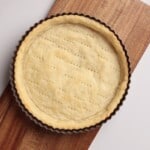
Homemade Quiche Crust Recipe
Easy homemade quiche crust recipe, flaky, buttery, no soggy bottom, no shrinking. Perfect base for any quiche filling.
Servings: 8
Calories: 154kcal
Ingredients
- 2¼ cups All-purpose flour
- ¾ cup Butter cold and cubed
- 1 teaspoon Salt
- 4-6 tablespoons Water ice cold (see notes)
Instructions
- Make the Dough: In a food processor, pulse the flour and salt to combine. Add the cold butter and pulse until the mixture resembles coarse crumbs with small pea-sized butter pieces.
- Gradually add the ice water, 1 tablespoon at a time, pulsing just until the dough starts to come together. Do not overmix.
- Chill the Dough: Transfer the dough to a work surface and gently bring it together into a disk (do not knead). Wrap tightly and refrigerate for at least 30 minutes.
- Roll & Shape: On a lightly floured surface, roll the dough into an 11–12 inch (28–30 cm) circle.
- Transfer to a 9-inch (23 cm) tart or pie pan. Gently press into the base and sides without stretching. Trim excess dough and prick the base with a fork.
- Freeze for 20–30 minutes (this helps prevent shrinking).
- Blind Bake: Preheat oven to 350°F (180°C).
- Line the crust with parchment paper and fill with pie weights or dry beans. Bake for 15 minutes, then remove weights and parchment. Return to oven and bake another 10–12 minutes, until lightly golden and dry.
- Ready to Use: Your crust is now ready for any quiche filling. Add filling and bake according to your recipe.
Video
Notes
- Keep everything cold: Cold butter = flaky layers. If your kitchen is warm, chill the dough again before rolling.
- Don’t overwork the dough: Overmixing develops gluten → tough crust. Mix just until it comes together.
- Why freeze before baking? Helps the crust hold its shape and prevents shrinking. If the pastry is too warm, it may shrink and slide down the sides while baking.
- No food processor? Use a pastry cutter or your fingers to rub the butter into the flour.
- Avoid soggy crust: Always blind bake for quiche, this keeps the bottom crisp even with a creamy filling.
- Make ahead: Dough can be refrigerated up to 2 days or frozen up to 2 months.
- Fix cracks easily: Patch with a small piece of dough before baking.
Nutrition
Calories: 154kcal | Carbohydrates: 0.2g | Protein: 0.2g | Fat: 17g | Saturated Fat: 11g | Polyunsaturated Fat: 1g | Monounsaturated Fat: 4g | Trans Fat: 1g | Cholesterol: 46mg | Sodium: 428mg | Potassium: 5mg | Fiber: 0.01g | Sugar: 0.01g | Vitamin A: 532IU | Calcium: 6mg | Iron: 0.02mg